2025-09-09
Summary of the 03 Pilot Initiatives on Dual Transformation
Within the IDAP Project – Inclusive Digital Acceleration Program, KisStartup has implemented the Dual Transformation model, combining Digitalization and Green Transformation. This model integrates digital technology and environmental protection solutions to create sustainable value for SMEs, cooperatives, and local businesses in Lao Cai and Son La.
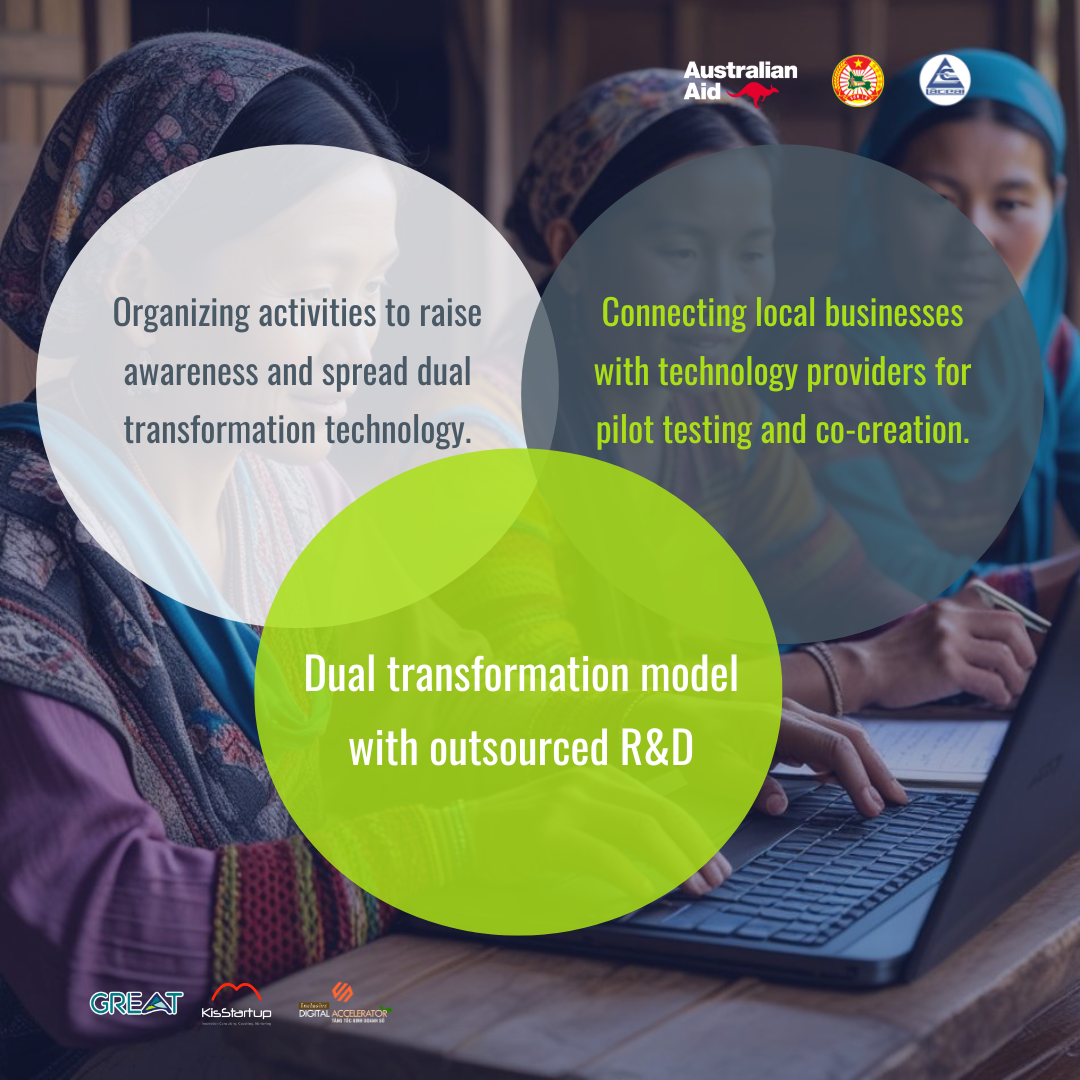
Three flagship pilot initiatives implemented:
1) Awareness-raising and diffusion of twin-transition technologies:
In partnership with international and domestic actors such as BTR Global, Sắc Mộc Tinh, Alterno, and scientists including Dr. Trần Chí Thành and expert Dr. Trần Văn Sỹ, KisStartup co-organized thematic workshops on digital and green transition. Deep-dive topics—agricultural by-product processing, renewable energy, resource circularity, plum-drying technologies, alkaline salts, and organic cleaning solutions—were presented in accessible formats for local residents, SMEs, and cooperatives.
2) Connecting local businesses with technology owners for piloting and co-creation:
A series of technology-application models were successfully implemented, including:
Măng Tân Xuân 269: Developing bamboo-leaf tea from agricultural by-products.
Forest Homestay Bản Liền: Producing de-astringent tea from mature leaves and herbal deodorizing sachets.
Na Ka Cooperative (HTX Nà Ka): Turning fresh plums into soft-dried plums to reduce seasonal losses.
Cuội Organic – Thai Chinh household business: Producing organic dishwashing liquid from home-grown fruit.
All of these products were developed in tandem with digital platforms, helping to amplify product storytelling, increase revenue, and create additional local jobs.
Key values of the twin-transition & outsourced R&D model
Digital transformation provides the platform for diffusion and commercialization; green transformation supplies the innovation engine:
Pursuing both pathways enables businesses not only to optimize processes but also to build brands on sustainable values, meeting rising consumer expectations.
Building trust and technological absorptive capacity in the community:
Beneficiaries do more than access technology—they receive training, run pilots, obtain market feedback, and are supported with testing and licensing procedures. This creates a closed-loop process and strengthens confidence on both the supply and demand sides of technology.
High scalability and suitability for SMEs:
According to Dr. Trần Chí Thành, the model KisStartup deploys does not require expensive machinery or advanced technical conditions. Leveraging local resources and simple production processes, paired with focused training and support, significantly lowers technology barriers—a major challenge for SMEs.
The early success of the twin-transition and outsourced R&D model opens a fresh, effective pathway to building innovation capacity for small and medium-sized enterprises in mountainous provinces. The establishment of Twin-Transition Working Groups in Lào Cai and Sơn La—with the voluntary participation of pioneering businesses and cooperatives—demonstrates the vitality and diffusion potential of this initiative. KisStartup believes the model can continue to expand into sectors such as medicinal herbs, community-based tourism, and OCOP products (One Commune One Product), thereby fostering a green–digital–sustainable innovation ecosystem at the local level.
About the IDAP project
IDAP (Inclusive Digital Accelerator Program) strengthening an inclusive digital-transformation ecosystem for SMEs focused on agriculture and tourism in Lào Cai and Sơn La is funded by GREAT (Gender Responsive Equitable Agriculture and Tourism). KisStartup JSC is the lead implementing partner for 2024–2027.
The project “Promoting Gender Equality through Improving Agricultural Economic Efficiency and Tourism Development in Lào Cai and Sơn La” (GREAT) is funded by the Australian Government and managed by Cowater International. Phase I ran from 2017–2022; Phase II (GREAT 2) runs from 2024–2027 with total Australian Government investment of AUD 67.4 million.
For enquiries, please contact
- Fanpage: https://www.facebook.com/kisstartup
- Website: https://www.kisstartup.com/
- Email: hello@kisstartup.com
- Contact: (+84) 0396 292 442 (Ms. Xuan)