2025-11-18
Lesson 6. Lean + AI = Lean 4.0 – Running a Startup with Discipline in the Age of Artificial Intelligence
Nguyễn Đặng Tuấn Minh
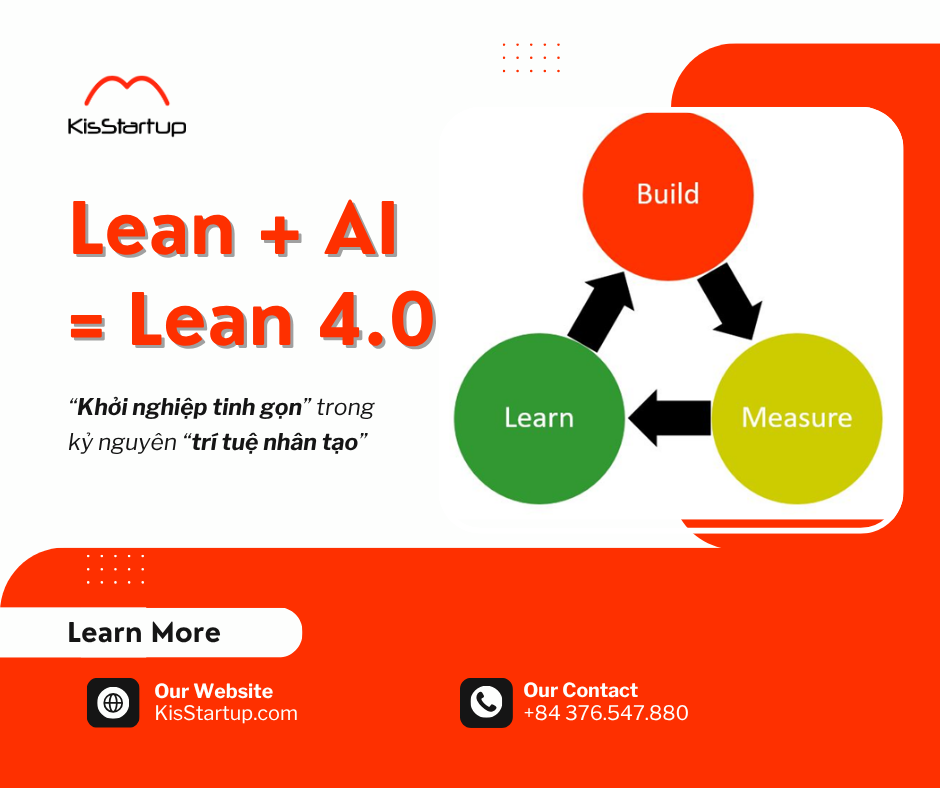
If Lean Startup is “the art of learning fast in uncertainty,” then AI is “the turbo engine” for that art. When the two meet, we get Lean 4.0: the Build–Measure–Learn loop accelerates exponentially, decisions rest on richer data, and core assumptions are challenged in real time. Yet this is exactly where questions of ethics, responsibility, and integrity rise: What are we learning fast for? Using whose data? With what impact on people and the environment?
This article takes a pragmatic view: AI does not replace Lean—AI makes Lean more serious. Your ability to learn from failure only improves when you turn AI into a critical ally, place it in the right steps of the learning loop, and keep data ethics as part of your innovation accounting.
Lean 4.0: From a Product Loop to a Cognitive Loop
In classical Lean, we build an MVP, “touch” the market, measure responses, and learn what’s right. In Lean 4.0, AI intervenes in all three stages:
- During Build, AI helps sketch solutions so quickly that an idea in the morning can become a functional demo by the end of the day. Copy-paste a landing page, auto-generate product descriptions, create virtual support agents—this is how a two-person team can perform the workload of a 6–8 person team.
- During Measure, AI “reads” data instead of forcing you to stare at it: it auto-classifies feedback, detects emerging themes, suggests customer segments with distinct behaviors, and alerts anomalies in funnels. Measurement is no longer manual digging; it becomes a translation from raw behavior to strategic questions.
- During Learn, AI acts as your internal challenger—posing counter-questions, simulating “what-if” scenarios, modeling the impact of changes in messaging, pricing, or channels. In other words, AI lets you rehearse failure on the table before failing in the market.
This does not make humans redundant. In fact, as manual tasks become cheaper, the quality of the team’s questions becomes the real competitive edge.
“Lean Failure” + AI: Learning More from the Same Misstep
Looking back at case studies from years of analyzing lean failures—Cyhome (multi-layered B2B, shifting markets), NemZone (pivoting from restaurants to households), or the vertical farming tower project (shutting down based on evidence)—they share one pattern: seeking behavioral truth faster than the founders’ ego. With AI, each journey could have been shorter:
- For Cyhome, instead of “walking the market” for months, AI could map stakeholders—residents’ forums, building management groups, service providers—and extract key pain points from natural-language data. The result: a positional MVP with differentiated messages and value propositions for residents, managers, and vendors—raising the chance of product-market fit on day one.
- For NemZone, AI could “read” comments, inbox messages, and orders to detect early household signals: phrases like “for my kid,” “breakfast,” “12-minute bake.” Instead of debating “healthy messaging,” the team could pivot toward convenience–speed–ready-to-eat before burning cash on new outlets.
- For the farming tower, AI-assisted patent search and novelty matching could have shown early the lack of technical defensibility. Pain arrives earlier—but cheaper: a project closed by evidence, not faith.
All of these are “lean failures”: detecting divergence early, closing learning loops quickly, and adjusting direction using meaningful data. AI simply sharpens and accelerates this rhythm.
AI as a Critical Mentor Inside Your Organization
At the team level, AI can take on three roles:
The Opening Scribe: drafting problem statements, suggesting experiment variants, scaffolding landing pages, preparing “non-leading” interview scripts. What matters is the team’s clarity: Which assumption is riskiest? What signal is strong enough to justify a pivot? What are the ethical limits of the experiment?
The Challenger: generating counterfactuals (“If assumption A were wrong, how would data look?”), running red-team simulations for messaging, forecasting PR risks of scaling fast. Using AI forces teams to write down “win–loss criteria” upfront—this is innovation accounting in discipline.
The Lesson Editor: after each loop, AI summarizes logs, tags assumptions, and links insights across teams. Knowledge no longer dies in personal files; it becomes searchable learning capital, forming the foundation for organizational learning velocity.
The key point: humans define the questions and decision thresholds. AI amplifies.
Ethics, Responsibility, and Integrity: Going Fast Without Losing the Way
Three risk zones must be addressed clearly:
Integrity of information. AI can hallucinate. If you present AI-generated content as fact, you distort your learning loop: you’re measuring user reactions to something nonexistent. The remedy: traceable labels—mark all experimental content as “simulated/ideation,” and only draw conclusions from real behaviors (purchase, usage, repeat).
Privacy and data consent. Lean 4.0 turns operational data into “the new oil,” but without explicit consent, you’re “drilling illegally.” Apply data minimization, anonymization, and provide deletion rights. Learn right—and clean.
Environmental impact. Training/deploying large models consumes energy. “Lean” without resource frugality is contradictory. Startups should favor small–medium models (SaaS/edge), controlled inference, auto-shutdown, and conscious accuracy–cost tradeoffs. Track “energy footprint” as a field in innovation accounting: how much learning is enough, at what cost?
Finding Early Adopters Is Not Enough—How AI Helps You Cross the Chasm
B2B requires early adopters, but staying there stalls growth. AI helps cross this chasm in two ways:
- Hyper-micro segmentation from interaction data to identify “replicable behavior clusters.” Instead of saying “apartment buildings,” say: “300–500 unit buildings, autonomous management boards, 25–40 age households >40%, currently using app A/B.” That is a replicable template—not just “the first customer.”
- Predicting word-of-mouth pathways through relationship graphs: who are the “spread nodes,” what conditions activate them, and what stories they repeat. No more “good luck with referrals”—design referral propagation as a feature.
Still, AI cannot replace trust. In B2B, selling the second and third time is the real proof. AI just helps you get there faster—and cheaper.
Lean 4.0 at Work: A New Learning Rhythm for Enterprises
When implementing AI with a Lean mindset, don’t begin with “Where do we apply AI?” but with “What do we need to learn in the next 30 days?” From the question comes the tool; from the tool comes the rhythm:
- Monday Learning: AI synthesizes customer signals inside and outside the company; the team reads for 15 minutes and picks one assumption to test.
- Thursday Testing: a micro-MVP goes live (message, pricing, channel variants); AI measures in real time with clean logs.
- Friday Reflection: AI prepares summaries; the team chooses whether to continue, adjust, or stop. Learning leads to action.
Repeat for 4–6 cycles and you’ll see AI’s real impact: not a “magical revenue curve,” but a steep learning curve. And that curve pulls revenue upward—on time and with less waste.
Mini-Playbook: A Meaningful AI-Driven MVP (Few Bullets, More Discipline)
An AI-enabled MVP “goes live” only when these three questions are clear:
- Meaningful – What assumption are you testing that, if wrong, collapses your plan? What signal is enough to conclude?
- Valuable – What real value does the user receive during the test (time saved, convenience, emotional benefit)? No value, no real data.
- Practical – Can you deploy and measure it within ≤2 weeks? If not, shrink it until you can—while keeping the core question intact.
Add three ethical “locks”:
- Transparency: Label all AI-generated content; no staged or fake testimonials.
- Consent: Explain what data is used for, how long it’s stored, who accesses it, and allow withdrawal.
- Energy footprint: Track training/inference costs; choose lighter solutions before heavy ones.
When the three questions and three “locks” are addressed, you have an MVP–AI that is meaningful, valuable, practical—and ethically clean.
Lean 4.0: Move Fast, Learn Deep, Stay Honest
Lean 4.0 is not “Lean plus a chatbot.” It is disciplined learning amplified: sharper questions, smaller but more frequent experiments, denser yet cleaner feedback. AI helps us fail earlier—and smarter: instead of spending months on a vague assumption, we focus on a few big questions and use AI to examine every angle before stepping into the market.
But because we move faster, we must be more honest—with data, with customers, with our ethical boundaries, and with the environmental footprint of what we build. Lean teaches us to reduce waste; in the AI era, the biggest waste is not money—it is trust.
“AI won’t make you fail less. AI makes each failure more worthwhile.”
— KisStartup, Lean 4.0 – Learning Fast in Uncertainty, Learning Clean in the Age of Machine Learning
© Copyright belongs to KisStartup. Any reproduction, citation, or reuse must clearly credit KisStartup.
- Log in to post comments
- 55 views