2025-11-25
Lesson 9. Lean Startup in Approaching Investors – Learning to “Raise Capital Leanly” Instead of “Asking for Money”
Nguyễn Đặng Tuấn Minh
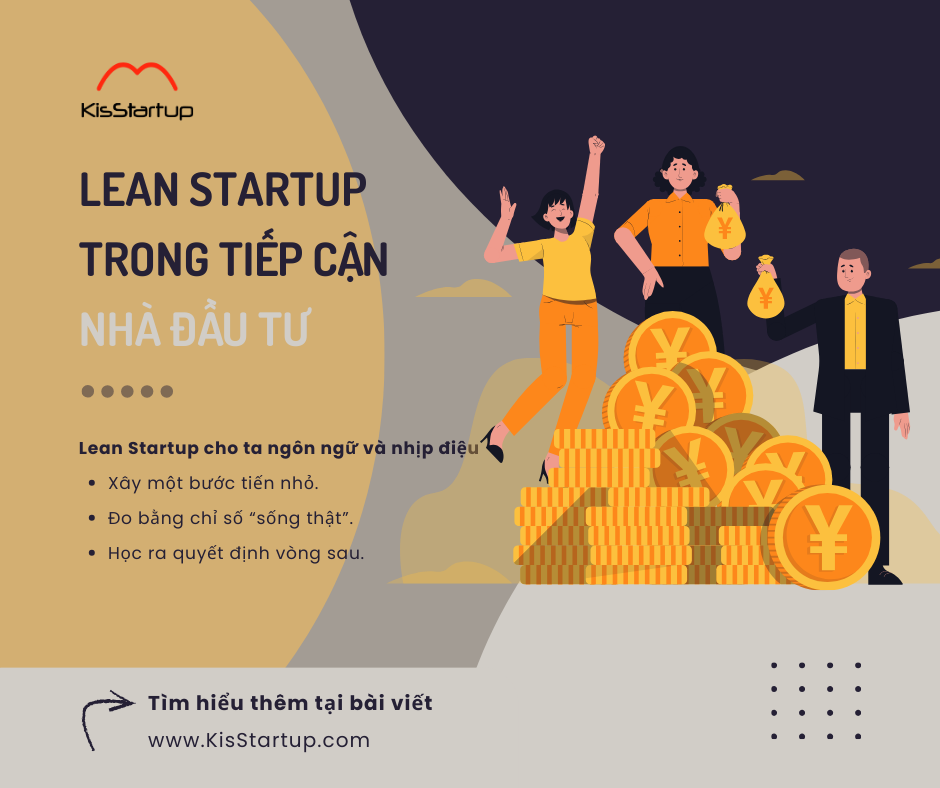
There is an uncomfortable truth: most pitching sessions fail not because the idea is bad, but because there is no evidence of learning. Investors don’t buy blueprints; they fund disciplined learning. Lean Startup gives us the language and rhythm to turn fundraising into a real Build–Measure–Learn cycle: build a small step forward, measure with “real signals,” and learn to make the next decision. When you raise capital this way, you’re not “begging” for money; you’re inviting investors into a running loop of progress.
Over ten years of accompanying startups, KisStartup has seen both sides: deals that unlocked growth at the right moment—and opportunities lost simply because the data was hollow, the signals were noisy, or expectations were misaligned. This article synthesizes a practice-oriented perspective: what investors expect, where startups typically go wrong, and how to raise capital leanly—lean in assumptions, lean in evidence, lean in narrative.
The “marriage” between investors and startups begins with… progress
Comparing “choosing investors to choosing a life partner” isn’t just a fun metaphor. Marriage operates on trust; the strongest trust is built on repeated behavior. It’s the same in startups: professional investors rarely require a perfect solution; they look for a trajectory of progress. How do you understand the market better today than yesterday? Is this learning repeatable? Do you have the discipline to keep going when assumptions break?
From their perspective, four lenses appear frequently—not as a static checklist, but as a way to read your learning loop:
- Market: large enough size, painful enough demand, open timing window. What they want to see is behavioral proof: deposits, trial payments, pilot contracts, binding letters of intent (LOI with terms).
- Team: ability to learn fast, complementary roles, just enough consistency to avoid random pivots, and just enough humility to correct early.
- Product/Technology: what is new, what is hard to copy, and more importantly: which real pain this novelty has already touched in the field.
- Finance & Model: how you make money today, how that changes as you scale, and which assumptions have been validated with data.
If fundraising is “selling the future using present-day evidence,” then the most valuable evidence isn’t glossy slides—it’s the trace of validated learning.
Three common mistakes we encounter
1) “Market validation is the staff’s job”
Outsourced surveys, dozens of superficial interviews, reports filled with charts—but the founder has never spent an hour with a real customer. The result? Strategic decisions based on the team’s “echo,” not the customer’s voice. Lean demands the opposite: the founder must be the first person to hold raw data. You can delegate the running, but not the understanding.
Practical suggestion: for every major assumption cycle (problem, solution, pricing, channel), conduct at least 20 deep conversations led directly by a founder. Each conversation needs a timestamp, current cost, decision influencer, and a small commitment behavior after the interview (signing up for pilot, leaving payment info, refundable deposit). Without behavior, data remains… opinion.
2) “More than 100 data points is enough
The number of interviews doesn’t equal depth of learning. We’ve seen spreadsheets boasting “100 responses,” but the questions are closed, the answers are polite, and no real motivations are revealed. Investors value insight saturation, not sample count. Saturation appears when answers begin repeating within each target segment, and each segment links to a clear action implication (message change, channel shift, package restructuring, payer change).
Practical suggestion: instead of showing “100 surveys,” highlight three pivotal insights that led to three decisions and three measurable changes (e.g., CTA change increased sign-up completion from 9% to 17% in 14 days on channel X; pricing moved from A to B, paid-pilot close rate doubled; removed feature C, onboarding time dropped 30%).
3) “Not preparing traction as a learning story”
Traction is not “how much revenue”; it is the chain of evidence showing you’re approaching product–market fit. Many teams bring aggregated totals (downloads, sign-ups) and stop there. These numbers rarely convince. Investors want context: cohort return rates, B2B sales cycle length, CAC at pilot scale, funnel conversion step-by-step, willingness-to-pay after experiencing—or not experiencing—the core feature.
Practical suggestion: tell traction as a storyline:
“January: validated problem with 27 B2B customers; February: ran 5 paid pilots; March: closed first 12-month contract at USD 2,000 with renewal clause; sales cycle dropped from 78 to 49 days after changing ROI messaging; NPS for users of feature X is 46; 90-day churn 3.8% due to [reason], resolved by [action].”
Any number that doesn’t trigger a next action is decoration.
Lean fundraising: build the loop of learning – validation – raising
Define the assumptions of your fundraising cycle
The money you seek is fuel for a big experiment, not a warm blanket. State clearly: with amount Y in Z months, you will prove A–B–C at what standard (e.g., 20 B2B paid contracts at minimum USD 1,500/year; sales cycle < 60 days; CAC < 40% of first-year LTV). When standards are clear, decision branches are clear: hit → scale; miss → cut/pivot.
Create a lean Data Room
A lightweight but complete data room signals disciplined information management—a strong sign of execution capability. In practice, 8–10 documents are enough for early rounds:
- One-pager & deck (problem, solution, market, model, team, fundraising roadmap)
- Traction timeline with annotations on “pivot points”: what changed – why – results
- Customer interviews/insight summaries (include 5–7 strong verbatim quotes)
- 12–18 month plan: milestones, budget by category, key assumptions, risks & mitigations
- Unit economics table (to the extent of “knowing what you don’t know”: weak assumptions & how you're validating them)
- Framework term sheet (capital needed, use of funds, runway, milestones for next round)
“Investment is also learning”: choose investors like co-authors
Lean doesn’t encourage “taking money at all costs.” The best round is the one that adds intelligence. A simple practice: ask reverse questions. You are not in a “petition–approval” position; you’re finding a partner. Direct questions save enormous pain:
- What is your maximum check size for this round, and what role do you expect to play?
- How long is your due-diligence process, and what points can cause a stop?
- In your current portfolio, what is the most recent success/failure case and key lesson?
- Expected exit horizon? What level of operational involvement is “ideal” for you?
Their answers reveal alignment. Good partnerships start with honest agreements.
Storytelling that makes investors want to “enter your loop”
Don’t present like a dry chronicle. Tell it like an investigation:
- We believed X.
- We defined X by behavior Y and set standard Z.
- We tried A; results diverged; root cause was B.
- We fixed C; remeasured; trajectory shifted to D.
- Now we need capital to validate E at scale F before unlocking G.
This narrative sounds honest and shows you’re steering. That builds trust.
A note for the Vietnamese market
We are fast adopters of technology, but many companies are slow to build data discipline. When raising capital, this weakness shows instantly: scattered data, non-standard definitions, no chain of decisions tied to data. Fixing it isn’t hard, but requires commitment:
- Standardize internal metric definitions (active user, MQL/SQL, churn, MRR/ARR, CAC/LTV…)
- Map data touchpoints along the customer journey and assign “ownership” for each
- Design a living traction dashboard: update 5–7 key metrics weekly with root-cause notes + actions
- Store raw customer voice; a few honest quotes often beat a hundred rows of numbers
Investors don’t demand perfection; they demand that you are becoming more correct—with evidence.
Fundraising is also a product—and Lean is how you “design” it
Treat fundraising as a “product” you must fit to a specific investor segment. Define your “customer profile” (sector, risk appetite, check size, horizon), test “distribution channels” (warm intros, demo days, angel communities, sector-focused funds), price reasonably for your stage (reflecting risk + potential, not dreams), measure “conversion rates” across steps (open email → schedule meeting → due diligence → term sheet → disbursement), and learn at each drop-off node.
Lean doesn’t guarantee you’ll secure funding; it guarantees you’ll secure yourself: knowing what you’re learning, how far you’ve learned, and what you need to learn next with new resources. When you enter the meeting with that mindset, any pitch—successful or not—becomes a profitable learning loop. Because whether you receive money or not, you walk out with better questions and clearer evidence for the next cycle.
And that is the essence of Lean Startup: not asking for permission to continue—but learning enough to continue.
© Copyright belongs to KisStartup. Any form of copying, quoting, or reuse must clearly cite KisStartup as the source.
- Log in to post comments
- 16 views