Sustainability

Unicorn Startups in Recycling: When Waste Becomes a Resource in the New Economy
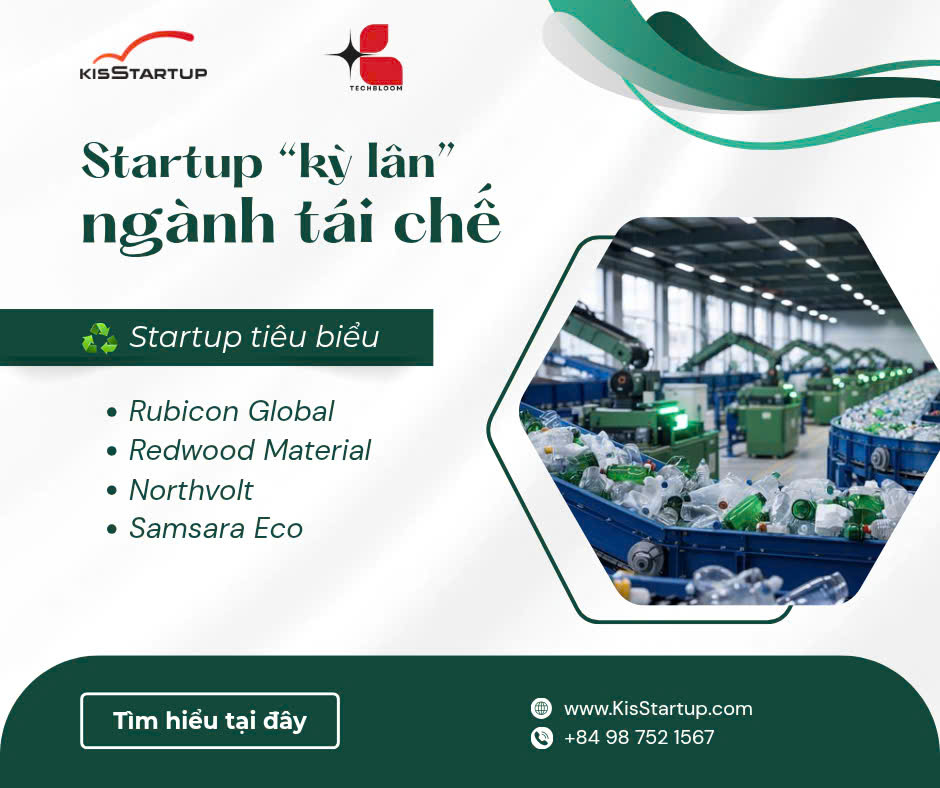
Over the past several years, recycling has evolved beyond a purely environmental issue. With the advancement of technology and the emergence of the circular economy, the recycling sector is becoming a large-scale, technology-driven startup domain, attracting hundreds of millions to billions of dollars in investment.

Some startups have already achieved unicorn status (valued at over $1 billion) or are rapidly approaching this milestone. Notably, these companies are not simply applying traditional recycling methods; instead, they integrate technology, data, and innovative business models to reconstruct the entire material value chain.

Below are several representative examples.

Rubicon Global (United States) – “Uber for Waste”
Rubicon Global has developed a SaaS-based waste management platform that connects businesses, governments, and waste collection providers.

Instead of fragmented, independently managed waste systems, Rubicon’s platform enables:

  • optimization of collection routes
  • reduction of operational costs
  • real-time waste data tracking

Through its platform-driven approach and use of big data, Rubicon has surpassed a $1 billion valuation, becoming one of the earliest unicorns in the waste management industry.

Redwood Materials (United States) – Battery Recycling for the Electric Vehicle Era
Redwood Materials was founded by a former Tesla CTO with the mission of addressing a critical challenge in the electric vehicle industry: end-of-life batteries.

The startup recovers valuable materials such as:

  • lithium
  • cobalt
  • nickel

from used batteries and reintegrates them into the battery manufacturing supply chain.

Currently, Redwood processes over 90% of recycled lithium-ion batteries in North America and is building industrial-scale facilities to support the rapidly expanding EV market.

Northvolt (Sweden) – Green Batteries by Design
Northvolt is a European battery company with a distinctive strategy: designing batteries from the outset for efficient recyclability.

Rather than focusing solely on post-use waste treatment, Northvolt emphasizes:

  • designing batteries for recyclability
  • using recycled materials in production
  • building a circular battery supply chain

The company has raised over $600 million and is regarded as one of the leading green unicorns in the battery industry.

Samsara Eco (Australia) – Enzyme-Based Plastic Recycling
One of the world’s most significant challenges is the difficulty of recycling plastics.

Samsara Eco has developed enzyme-based technology capable of breaking plastics down into their original molecular building blocks, enabling the production of new plastics with performance equivalent to virgin materials.

This innovation opens the possibility of “infinite recycling,” significantly reducing the volume of plastic waste sent to landfills or incineration.

Other Notable Startups
Beyond unicorns and near-unicorns, several other startups are developing highly promising models:

  • PureCycle Technologies (United States) – high-quality polypropylene recycling
  • UBQ Materials (Israel) – converting household waste into plastic alternatives
  • Ioniqa (Netherlands) – PET recycling using magnetic nanoparticle technology
  • Rekosistem (Indonesia) – digital platform for waste collection ecosystems
  • Grac (Vietnam) – digital waste management system development

Key Lessons for Technology Startups and Students
Successful recycling startups typically share three core characteristics:

  • strong core technologies such as enzymes, advanced materials, hydrometallurgy, and artificial intelligence
  • data-driven or platform-based business models to optimize waste management systems
  • a value chain mindset, focusing not only on recycling but on redesigning the entire material ecosystem

This highlights an important insight:
entrepreneurship in the environmental sector is not only about sustainability, but also represents a significant business opportunity within the circular economy.

For today’s student entrepreneurs, waste, materials, and secondary resources may become one of the largest technology markets of the coming decade.

© Copyright belongs to KisStartup. Any reproduction, citation, or reuse must clearly credit KisStartup as the source.
Author: 
KisStartup

7 Proactive Steps for Green Export – From ESG Thinking to Creative Action

In the global context, green, sustainable standards, and ESG (Environmental – Social – Governance) have increasingly become not just "external requirements" but a core foundation for businesses to affirm their position and create long-term export opportunities. Many Vietnamese businesses are still accustomed to a passive approach – only changing when requested by partners. However, real-world examples from successful businesses show that proactively starting from within – from the business model and internal governance – creates a creative path, aligns with resources, and provides sustainable competitive advantages.

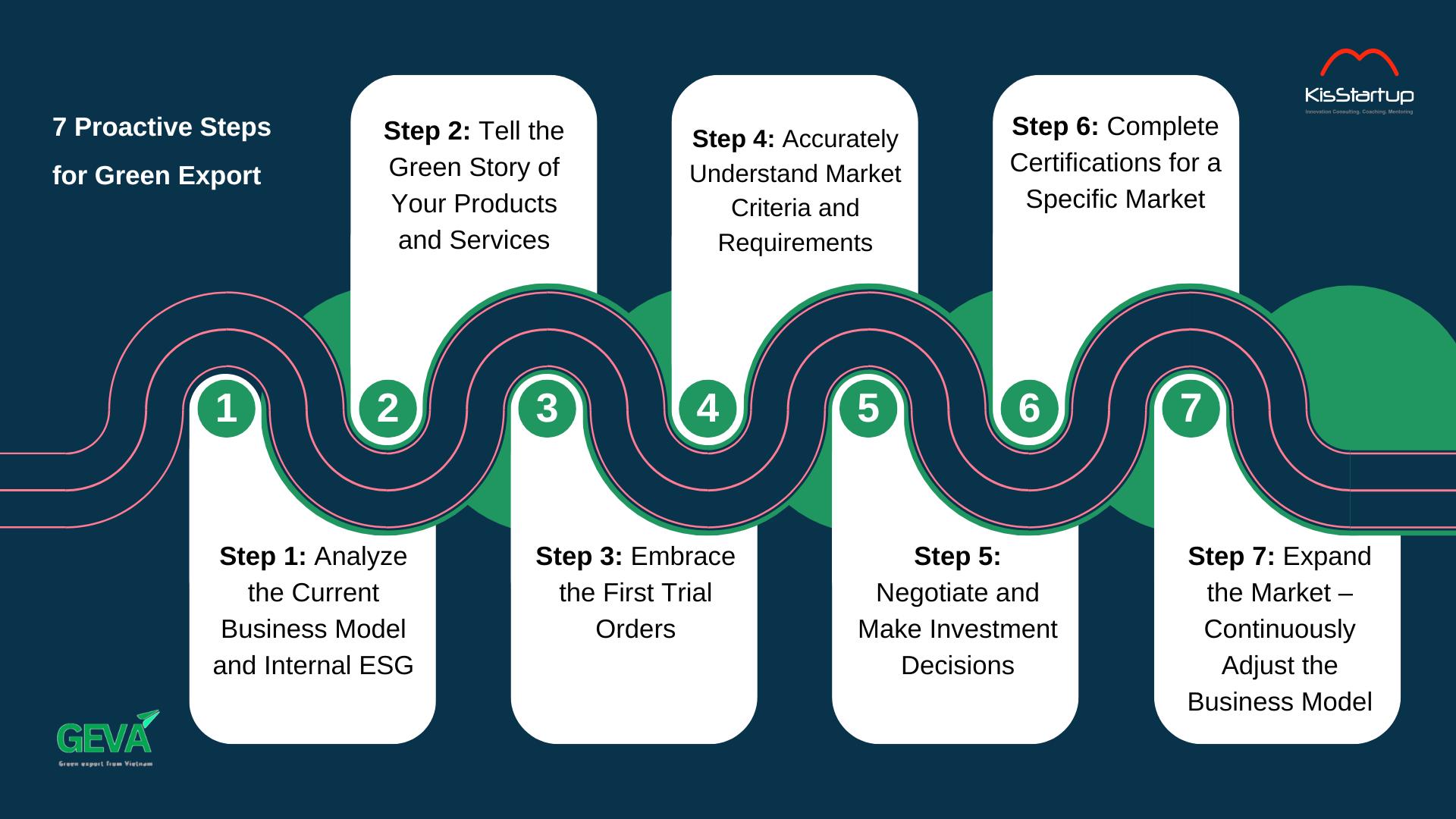
KisStartup has compiled and analyzed 7 proactive steps to help businesses enter green export effectively:

Step 1: Analyze the Current Business Model and Internal ESG
The starting point is not from the outside, but from within the business itself. Dissect your current business model according to the 9 components (Canvas) and ask: What is the level of E (Environmental), S (Social), and G (Governance)? What needs improvement?
For example: Does the production process cause waste of materials? Is the team fairly compensated? Is the governance system transparent and tracking ESG effectiveness?
From there, develop a specific strategy to integrate ESG into your business model rather than just treating it as a slogan.

Step 2: Tell the Green Story of Your Products and Services
Today's global customers are not just buying products, they are buying the story and values behind them. Be proactive in sharing your sustainability journey:

  • How are farmers supported?

  • How does your production process save water and energy?

  • How has your company reduced emissions, recycled, or contributed to society?
    Use your website, social media, catalogs, and fairs to build trust and differentiate yourself before the market raises questions.

Step 3: Embrace the First Trial Orders
Once you’ve shared your story, the market will provide feedback. Small trial orders from abroad are opportunities for testing. At this stage, businesses should:

  • Understand the needs and consumption habits of international customers.

  • Compare with current capacity and resources.

  • Identify gaps to be filled for further progress.
    Be proactive in learning from the market through each trial order to adjust quickly and minimize risk.

Step 4: Accurately Understand Market Criteria and Requirements
Each market and customer has different standards. Instead of vaguely aiming to be “green,” clarify specific criteria:

  • What is the maximum allowable chemical content?

  • How is traceability handled?

  • Which certifications are mandatory?
    Proactively reach out to trade organizations, participate in programs like GEVA or SwissTrade, or communicate directly with partners to “translate” requirements into actionable internal processes.

Step 5: Negotiate and Make Investment Decisions
At this stage, businesses need to face reality: with outputs in place, it’s time to invest. Negotiate with customers on purchase commitments, then decide:

  • Invest in new technology to meet standards.

  • Enhance human resources to manage ESG.

  • Adjust processes for greater transparency.
    This is the “risk-balancing” step between market requirements and internal capabilities.

Step 6: Complete Certifications for a Specific Market
Instead of spreading across multiple certifications at once, focus on a priority market and achieve sustainable certifications (Organic, Fairtrade, Rainforest Alliance, etc.).
Certifications are not only a “pass” but also a commitment that demonstrates your ESG journey.

Step 7: Expand the Market – Continuously Adjust the Business Model
Once successful in one market, use that experience and evidence to expand into other markets.
At the same time, continuously ask: Does the current business model still align with the new ESG context? What needs to change? The mindset of “proactively checking and adjusting” will help businesses remain flexible and not passively follow trends.
Green export is not just about “meeting partner requirements,” but a long-term strategy to create value and sustainable differentiation for Vietnamese businesses. By starting with their own business model, creatively integrating ESG, telling their story, and expanding step by step, businesses can proactively seize opportunities and design their own path to the global market that fits their resources and advantages.

To accompany businesses on this journey, KisStartup and the GEVA project have developed a set of 3 measurement tools to help businesses self-assess, self-adjust, and proactively shape their green export path:

  • Export Readiness Measurement Tool – Helps businesses know where they are in their export journey and what they need to prepare.

  • Green Export Compliance Measurement Tool – Compares processes and products with green standards (VSS, Organic, Fairtrade, etc.).

  • Green Business Model Measurement Tool – Analyzes the current business model and finds creative paths that align with E, S, and G elements.

Businesses can start today by using these tools to map their own path instead of waiting for partner requirements.

© Copyright belongs to KisStartup. The content was developed as part of the Green Export Incubator and Accelerator Program through Voluntary Sustainability Standards (VSS) project. Any form of reproduction, citation, or reuse must clearly credit KisStartup/GEVA as the source.


Author: 
Nguyễn Đặng Tuấn Minh - KisStartup