Unicorn Startups in Recycling: When Waste Becomes a Resource in the New Economy
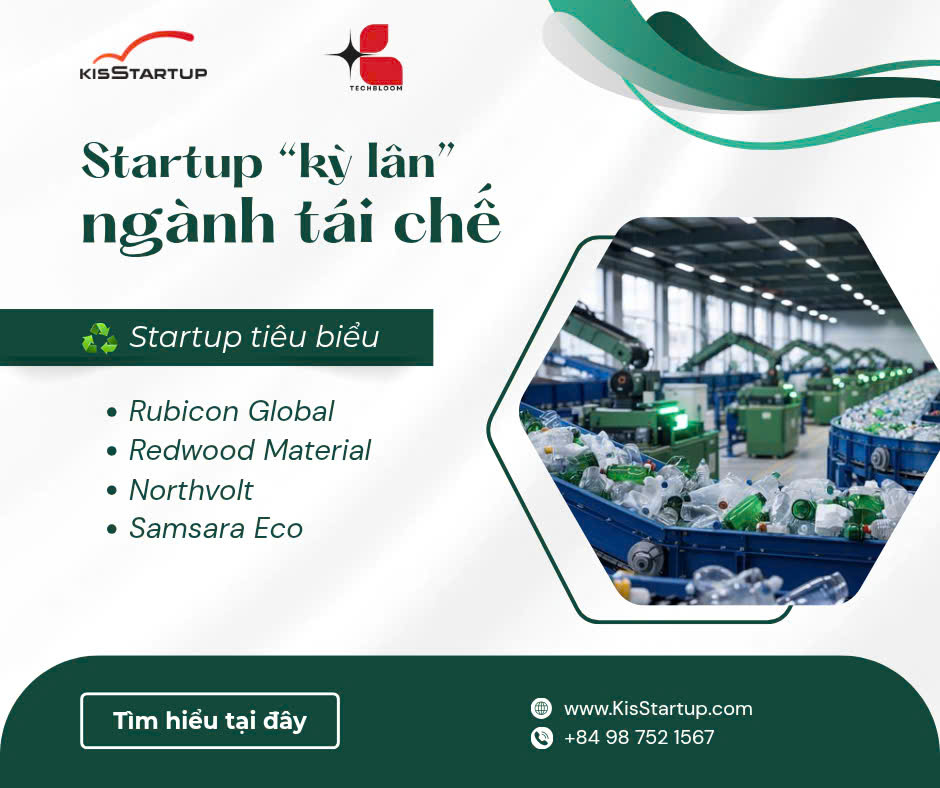 Over the past several years, recycling has evolved beyond a purely environmental issue. With the advancement of technology and the emergence of the circular economy, the recycling sector is becoming a large-scale, technology-driven startup domain, attracting hundreds of millions to billions of dollars in investment.
Some startups have already achieved unicorn status (valued at over $1 billion) or are rapidly approaching this milestone. Notably, these companies are not simply applying traditional recycling methods; instead, they integrate technology, data, and innovative business models to reconstruct the entire material value chain.
Below are several representative examples.
Rubicon Global (United States) – “Uber for Waste”
Rubicon Global has developed a SaaS-based waste management platform that connects businesses, governments, and waste collection providers.
Instead of fragmented, independently managed waste systems, Rubicon’s platform enables:
- optimization of collection routes
- reduction of operational costs
- real-time waste data tracking
Through its platform-driven approach and use of big data, Rubicon has surpassed a $1 billion valuation, becoming one of the earliest unicorns in the waste management industry.
Redwood Materials (United States) – Battery Recycling for the Electric Vehicle Era
Redwood Materials was founded by a former Tesla CTO with the mission of addressing a critical challenge in the electric vehicle industry: end-of-life batteries.
The startup recovers valuable materials such as:
- lithium
- cobalt
- nickel
from used batteries and reintegrates them into the battery manufacturing supply chain.
Currently, Redwood processes over 90% of recycled lithium-ion batteries in North America and is building industrial-scale facilities to support the rapidly expanding EV market.
Northvolt (Sweden) – Green Batteries by Design
Northvolt is a European battery company with a distinctive strategy: designing batteries from the outset for efficient recyclability.
Rather than focusing solely on post-use waste treatment, Northvolt emphasizes:
- designing batteries for recyclability
- using recycled materials in production
- building a circular battery supply chain
The company has raised over $600 million and is regarded as one of the leading green unicorns in the battery industry.
Samsara Eco (Australia) – Enzyme-Based Plastic Recycling
One of the world’s most significant challenges is the difficulty of recycling plastics.
Samsara Eco has developed enzyme-based technology capable of breaking plastics down into their original molecular building blocks, enabling the production of new plastics with performance equivalent to virgin materials.
This innovation opens the possibility of “infinite recycling,” significantly reducing the volume of plastic waste sent to landfills or incineration.
Other Notable Startups
Beyond unicorns and near-unicorns, several other startups are developing highly promising models:
- PureCycle Technologies (United States) – high-quality polypropylene recycling
- UBQ Materials (Israel) – converting household waste into plastic alternatives
- Ioniqa (Netherlands) – PET recycling using magnetic nanoparticle technology
- Rekosistem (Indonesia) – digital platform for waste collection ecosystems
- Grac (Vietnam) – digital waste management system development
Key Lessons for Technology Startups and Students
Successful recycling startups typically share three core characteristics:
- strong core technologies such as enzymes, advanced materials, hydrometallurgy, and artificial intelligence
- data-driven or platform-based business models to optimize waste management systems
- a value chain mindset, focusing not only on recycling but on redesigning the entire material ecosystem
This highlights an important insight:
entrepreneurship in the environmental sector is not only about sustainability, but also represents a significant business opportunity within the circular economy.
For today’s student entrepreneurs, waste, materials, and secondary resources may become one of the largest technology markets of the coming decade.
© Copyright belongs to KisStartup. Any reproduction, citation, or reuse must clearly credit KisStartup as the source.