business model

Afternoon Tea with KisStartup – When Biotechnology Touches Fashion: The Journey of TômTex
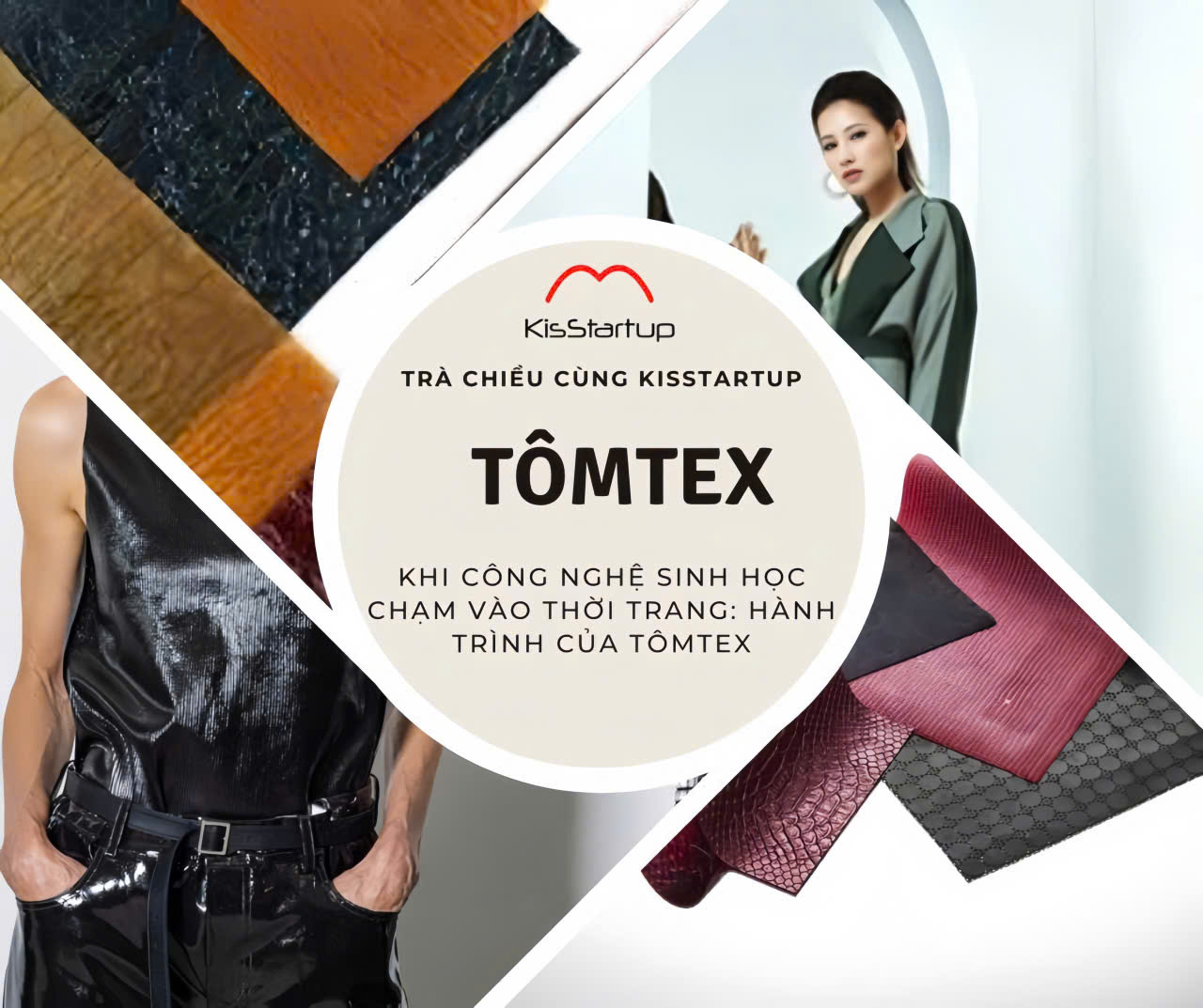
 

TômTex is becoming one of the most fascinating examples of how biotechnology and the circular economy can redefine the material landscape for the fashion industry. Born from a very “everyday” question — how far can shrimp shells, crab shells, coffee grounds, and fungi go in the global value chain — TômTex has built an ambitious business model: transforming agro-marine by-products into sustainable bio-based “leather,” targeting high-end fashion, interior design, and premium packaging markets.

Business Model: From Waste to High-Value Materials
Instead of investing in new raw-material farms or costly lab-grown cultivation, TômTex starts with the massive waste streams of seafood and agriculture. Shrimp shells, crab shells, coffee grounds, and fungal by-products — typically considered environmental treatment costs for businesses — are “upcycled” into inputs for biotechnology. Low cost, stable supply, and the added benefit of waste reduction form the first layer of value.

The core lies in TômTex’s proprietary green biochemical technology: chitosan extracted from shrimp shells is processed and combined with bio-based binders and natural pigments — with no plastics and no toxic solvents. The result is a material that can be printed, embossed, and pressed into various structures, mimicking cow leather, suede, or even PVC-like surfaces while remaining fully bio-based and biodegradable. Production costs are designed to approximate — or undercut — conventional cow leather, a crucial condition for mass commercialization.

In terms of market strategy, TômTex adopts a B2B model: selling materials to fashion, interior, automotive, and premium-packaging brands, while co-creating designs with influential designers and labels. Appearing on runways, at fashion weeks, and in experimental product lines of major brands not only generates initial revenue but, more importantly, builds “social proof” that this new material is beautiful, durable, and credible enough for the premium segment. Once trust is established, the logical next step is expansion into more affordable product lines and becoming a platform-level material supplier for OEM manufacturers.

The model also opens up a “Vietnam-rooted, globally scaled” pathway: placing R&D near fashion hubs and manufacturing technology centers while gradually shifting production back to Vietnam to leverage abundant shrimp, coffee, and fungal by-products — forming a closed-loop value chain from surimi plants, shrimp-processing factories, and coffee roasters to bio-material manufacturing and fashion–interior ecosystems.

Competitive Advantages and Global Comparison
In the landscape of next-generation bio-leather startups, TômTex stands alongside MycoWorks, Bolt Threads, and Desserto — but follows a different path. Many competitors invest heavily in mycelium cultivation or synthetic spider-silk proteins in tightly controlled environments — which ensures consistency but requires high capital and operating costs. Desserto uses cactus — strong in sustainable agriculture and “green” branding — but still faces technical challenges in processing, preservation, and additives for durability.

TômTex avoids the route of “new farming” or “new cultivation” and instead builds on existing waste streams. If executed well, this model creates a cost advantage that is difficult to replicate: near-zero raw material cost, potentially even “negative cost” if seafood companies treat it as waste-processing service. Chitosan processing, formulation, and structural engineering form the hard-to-copy technological core, especially once protected by IP and refined through long-term experimentation. Strategic partnerships with seafood enterprises, such as VNF, add another “moat” in the supply chain: whoever controls stable, pre-processed waste streams gains an edge in both price and quality.

However, from a critical perspective, TômTex still faces challenges: ensuring industrial-scale consistency; meeting strict standards for mechanical strength, moisture resistance, mold resistance, and colorfastness required by fashion and automotive sectors; and avoiding “greenwashing” skepticism unless product lifecycle and end-of-life biodegradability are clearly demonstrated. Competition in the vegan-leather space is intensifying, requiring continuous innovation to avoid being leapfrogged by newer technologies.

Opportunities for Biotechnology and Fashion Materials in Vietnam
If TômTex is seen as an “open case study,” the crucial question for Vietnam is: how can Vietnam move beyond supplying shrimp shells and coffee grounds to becoming an R&D and manufacturing hub for bio-materials in the global fashion supply chain?

Vietnam possesses a rare combination of assets: among the world’s top exporters of shrimp, pangasius, and coffee; a major global manufacturing base for textiles, apparel, and footwear; a network of universities and research institutes in biotechnology, biochemistry, and materials; and increasing pressure from international brands’ emission-reduction and ESG commitments. In other words, Vietnam has both the motivation and the resources.

Yet the linkages between labs, factories, and fashion brands remain weak. Many biotech research projects stop at academic publications, while textile and footwear firms mainly operate as OEMs dependent on imported materials. TômTex suggests a new model: bio-material startups positioned at the center, speaking “the language of all three sides” — understanding biological mechanisms, material technical requirements, and the aesthetic and business needs of designers and brands.

If Vietnam could build multiple “new-generation TômTex,” but with a broader range of raw materials — from shrimp and crab shells to coffee husks, cashew shells, banana trunks, coconut fibers, durian husks — the country could turn agricultural waste pressure into a national competitive advantage in green materials. This requires not only technology but also ecosystem and policy: encouraging collaborative experiments between startups, research institutes, and seafood companies; designing benefit-sharing mechanisms across the value chain; and supporting IP protection and international standard testing for new materials.

Strategic Potential for a Sustainable Strength
From a strategic perspective, TômTex presents an intriguing proposition: Vietnam can move up the global value chain not only by upgrading manufacturing capability but also by owning the next generation of foundational materials for the fashion and interior industries. If Vietnam can combine three pillars — green biotechnology, abundant agro-marine by-products, and existing fashion-design–manufacturing capabilities — the country could position itself as a regional “bio-fashion material hub.”

This requires long-term thinking: treating waste as a strategic asset; treating bio-material startups as key components of a sustainable fashion-industry strategy; and treating pioneers like TômTex as partners for learning, transfer, and co-creation — not merely as buyers of raw materials. If achieved, the journey “from shrimp shells to the fashion runway” would not only be the inspiring story of a single startup but also a story of national value-chain upgrading.

© Copyright belongs to KisStartup. Any reproduction, citation, or reuse must credit KisStartup as the source.

Author: 
KisStartup

Startup Case Study from Vietnam - UDr - Internet of Things (IoT) in health care – a platform business model in a developing country market

Internet of Things (IoT) in health care – a platform business model in a developing country market

1 Minh Nguyen Dang Tuan, 2 Thanh Nhan Nguyen
1 KisStartup Innovation Consulting, Coaching, Mentoring
2 Faculty of Business Administration, Ton Duc Thang University

Abstract

Ecomedic Medical System (EMS) is the largest community of online health care in Vietnam currently. Based on its diversifications of involvement of stakeholders from patients to doctors to pharmacies, the community is transitioning itself to an online application to connect different stakeholders, utilizing IoT application for the development. It is expected to officially provide the market with a deployment model for the home care physician system: proactive, continuous care in which all data are connected to the cloud. Key functions deployed with UDr, which is android or IoS applications, IoT wearable devices enable patients to use 24/7 health monitoring equipment (especially for patients with chronic diseases such as cardiovascular disease, diabetes, high blood pressure ...); The wristwatch automatically measures the time (defaults to 30p / s) and sends data to Cloud; The UDr application reads the data from the cloud to the physician for examination. Clinical examinations are also done at home and the results are sent to the doctor and the patient for follow up. When there are abnormalities (for example sudden increase in blood pressure within 3-4 hours), EMS's cloud service will analyze and alert the physician, patient/family member and connection. Unique value of the business model: a combination of deeptech solutions for the health care ecosystem. In a country where the average patient's waiting time is 10 hours, the development of UDr, an online patient care advisor on the basis of a smart medical community. UDr is a combination of different technologies that work to reduce the time spent on both patients and the healthcare ecosystem. Making use of the available IoT devices that are available to physicians for analysis of patient health data by providing real-time patient survival information, combined with a network of family physicians developed by another partner, the UDr offers warnings of hazards to the patient's health. The UDr is a flexible mix of online and offline and leverages the technology platforms and insights available to the market and integrates with existing solutions in the marketplace to benefit the user and bring value to the parties involved. Key words: Internet of Things, Health industry, startup

Case highlights
•Introducing Business model of Ecomedic Medical System in Vietnam, which is established by merging fours basis factors consisting of hardware platforms, wearables, networking technologies, and cloud platforms that connect different stakeholders in the healthcare ecosystem with wearable devices.
•Analyzing the present market in smart e-medical service in smart cities, and their relationship with professional medical experts, nurses, patient’s relatives.
•With a strong focus on quality of doctors and active prevention for patients with common diseases in Vietnam, UDr is targeting a potential market with no big competition.
•Integration of IoT, Big Data and Block Chain into the solutions creates its unique values.
•Using the Business Canvas Model to discuss the business opportunity in industry and future market potential. 

To download the casestudy, email us at: hello@kisstartup.com

Source: 2018 Business opportunities and innovative models driven by the Internet. Cases in Vietnam. Organizers: TDT University, Feng Chia University, PWC, TSing Hua University, 

Author: 
KisStartup

Startup Case Study from Vietnam - ABIVIN- IoT and Big Data for Smart City Route optimization with big data and the support of existing IoT platform

IoT and Big Data for Smart City Route optimization with big data and the support of existing IoT platform

Authors: Long Nam Pham (ABIVIN Corporation) , Dang Tuan Minh Nguyen (KisStartup Innovation Consulting, Coaching, Mentoring), Minh Tuan Phung (Innovation and Entrepreneurship Research Group, Faculty of Business Administration, Ton Duc Thang University)
Case study Introduction
Problem: Abivin vRoute was born to solve the problems facing logistics managers every day: Hours wasted by Deliverymen since actual workload below their capacity; No system to manage real-time delivery progress; Fraud on fuel claiming; Manually arrange daily delivery routes.
Advantage: Firstly, Abivin vRoute is the leading innovator in route optimization technology in Vietnam. For the first time, we hope to optimize automatically the delivery route planning and cut waste from missing spend on fuel and vehicles. Secondly, vRoute is the perfect fit for ASEAN countries with advanced intelligent algorithm handling unique ASEAN constraints such as bike or truck delivery, special store locations or time window… Last but not least, being the world-class solution for fleet management, vRoute is offered with a reasonable price for ASEAN markets, which lowers the budget that customers should bear while still benefiting from the whole package of useful functions.
Channel: The company is generating leads by both inbound and outbound channels. With respect to inbound leads, content marketing is our ultimate hook for short as well as long-term. To reach out to potential customers, we spend 30% of the effort to participate in events in the field of logistics, supply chain and related industries. Additionally, national and international competitions are also an effective way for us to gain popularity.
Model: As a SaaS company, ABIVIN charges user license fees every month. We offer a one-month free trial for enterprises to test if we're a fit. When one decides to purchase vRoute, they can choose from different packages to fulfil their need to the full extent. If a customer's in need of a new function out of the original version, we're ready to customize for them at a reasonable one-time payment fee. The price of vRoute is affordable for ASEAN countries, and we also offer on-site support for ASEAN countries. With the main target is FMCG companies and distributors in ASEAN, vRoute's system is planned to expand to other categories such as logistics service providers, or postal companies in the whole region in the next 3 years.

Keywords: Internet of Things, business model, big data

Case highlights
+ Delivering the gaps, which is determined by an emerging logistics industry in Vietnam and the rise of Industry 4.0? A panoramic glance at IoT application products market and opportunities for IoT-enabled a service system management in Vietnam;

+ Demonstrating the increasing need for IoT-based solutions to intelligent logistic and fleet management systems due to prevalence of smart devices;

+ Introducing and analyzing the case of ABIVIN – an emergent company whose products and business model canvas is the leading in Vietnamese market;

+ Strengthening the rising tide of high-tech start-ups; discuss the aims to propose the strategy for business to business model, which can be success in future.

+ Providing an actual business situation whose details and implications would be beneficial to future similar projects.

ABIVIN expects to call for investment in Serie A in 2018, opening up opportunities for the company to grow stronger in the future. The business model of ABIVIN up to now can sustain its competitiveness in the next 2-5 years. With the potential of Vietnam market, ABIVIN can completely dominate the market in terms of market share in 2years time. The biggest challenge with the business model is the time it takes to educate the market for a lot of time and because of the B2B model, the sales life cycle will not be short. The company might not experience rocket growth in the number of users due to the pressure of expanding staffing. Therefore, ABIVIN needs to continue to take care of existing customers and expand with the speed that can be controlled for new customers. The potential cooperation with ABIVIN is to expand the market and benefit from the expansion

To download the casestudy, email us at: hello@kisstartup.com

Source: 2018 Business opportunities and innovative models driven by the Internet. Cases in Vietnam. Organizers: TDT University, Feng Chia University, PWC, TSing Hua University, 

Author: 
KisStartup