Afternoon Tea with KisStartup – The Last Days of 2025
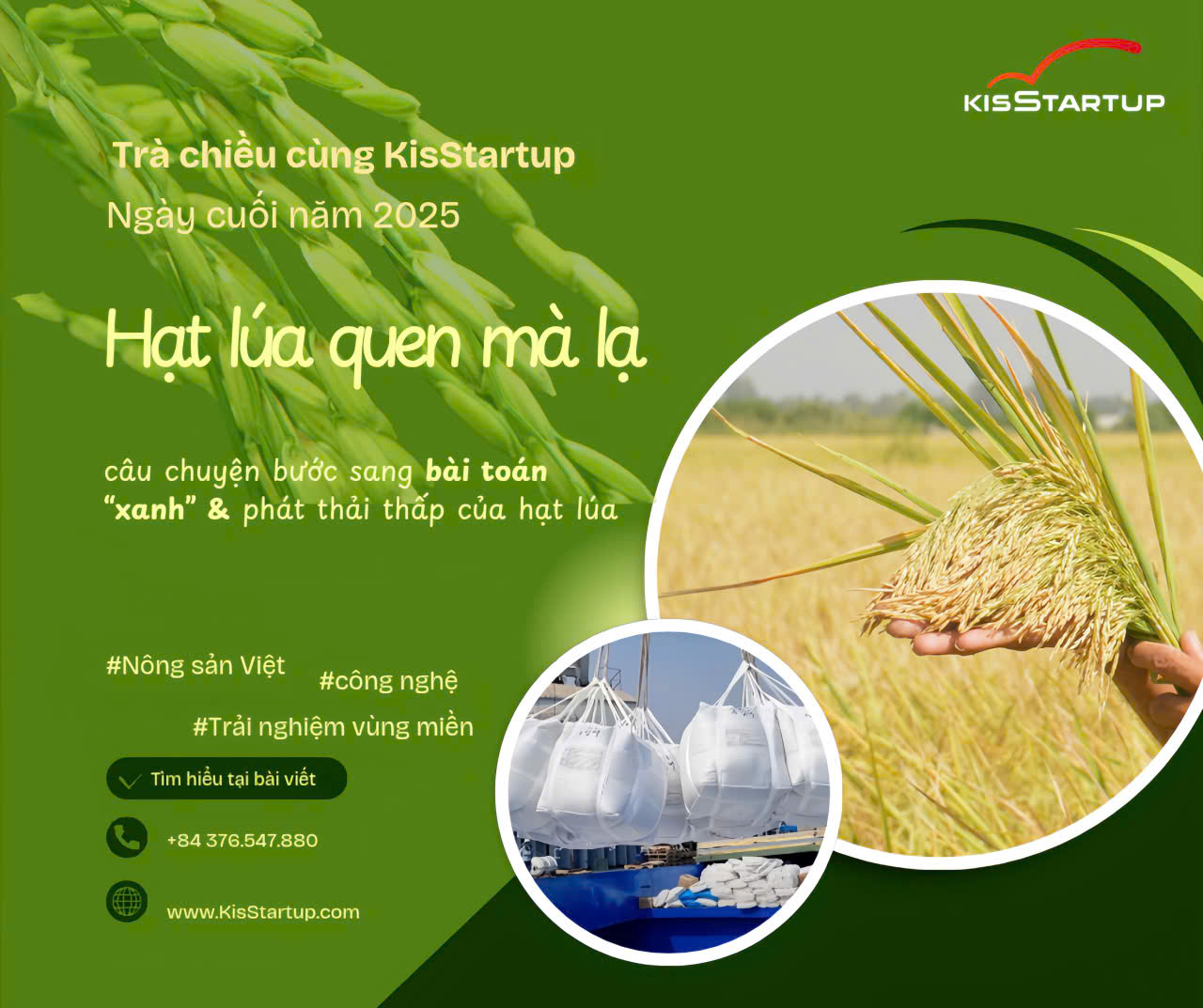
The Rice Grain: Familiar Yet Unfamiliar as Vietnam’s Development Enters the “Green” and Low-Emission Era
At the end of the year, when life slows down, KisStartup often reflects on things that feel deeply familiar. Rice is one of them. So familiar that we think we already understand it—yet also unfamiliar, because every year the rice grain is placed into a new equation.
In the past, rice was about harvests—producing enough to feed the nation in the years after war. Later, it was about price, as Vietnam stabilized production and opened to global markets. Then came standards, as Vietnamese rice entered demanding export markets. Today, rice faces a new challenge: it must be green. Green in ways that can be measured—emissions quantified, processes traced, methane reduced, and in the near future, potentially linked to carbon finance.
Looking back, rice has accompanied Vietnam through a long journey. From a food-deficit country, Vietnam became one of the world’s leading rice exporters, contributing to global food security. This achievement reflects hard work, technological improvement, and timely policy choices. Yet that same journey has created new challenges: soil degradation, increasing freshwater scarcity, and greenhouse gas emissions from rice cultivation becoming a significant part of agricultural emissions [1], [2].
Seeing Rice Through a Different Lens
For decades, the rice value chain followed a simple logic: inputs – yield – output – export, with value measured mainly in tons. But as climate change becomes a global concern and markets begin asking about the carbon footprint of products, rice is no longer just a commodity. It carries an additional layer of value: how it is produced.
Low-emission rice is therefore not just a technical concept—it represents a shift in development thinking. The question moves from “How do we produce more?” to “How do we produce smarter, with lower emissions, while still securing farmers’ livelihoods?”
In Vietnam, technologies for low-emission rice already exist. On the “inside of the seed,” research institutes are applying advanced breeding and biotechnology to develop rice varieties that emit less methane and are more resilient to drought, salinity, and climate extremes [3], [4]. On the “outside of the field,” practices such as sparse seeding, balanced fertilization, organic and bio-fertilizers, and especially alternate wetting and drying (AWD) irrigation have proven effective in reducing emissions, saving water and input costs, while maintaining or even improving yields [5], [6].
Alongside these are digital efforts: water-level sensors, farm management apps, electronic field logs, and digital extension tools. These technologies help turn farming experience into measurable and verifiable processes [1], [7].
The Gap Is Not Technology, but the Market
The biggest challenge today is not a lack of technical solutions, but the absence of clear market mechanisms that can convert low emissions into real economic value. Without reliable measurement, reporting, and verification (MRV) systems at field and production-area levels, “low-emission” remains difficult to turn into a tradable attribute [8]. When data are fragmented—stored in notebooks, paper reports, or human memory—the value chain cannot convincingly prove to international buyers that the rice is truly green.
More importantly, when benefit-sharing mechanisms from carbon reductions are unclear, farmers and cooperatives have little incentive to change long-established farming practices [2], [9]. As a result, many technologies remain stuck at pilot stages instead of becoming widespread practices.
An Opportunity to Redesign the Rice Value Chain
Yet the end of 2025 also brings promising signals. Large-scale programs on high-quality, low-emission rice are being implemented; green credit is increasingly linked to rice value chains; and rice straw is being reconsidered as a resource rather than waste to be burned [5], [10], [11].
From KisStartup’s perspective, this is the right moment to view rice not just as an agricultural product, but as the center of a new value ecosystem. In this ecosystem, value comes not only from rice itself, but from farming data, reduced emissions, restored soils, and new financial flows such as green finance and carbon markets.
New business models are emerging: companies building low-emission rice brands backed by data and traceability; service providers offering MRV solutions for cooperatives; digital platforms connecting farmers, enterprises, banks, and certifiers; and circular economy models that turn rice straw into organic fertilizer or biomass materials—creating revenue while cutting emissions [8], [10], [11].
Returning to the Land—With Technology
At a deeper level, the story of low-emission rice is also about how Vietnamese society reconsiders its relationship with land. Not just extraction, but care. Not just taking, but giving back. Healthy soil sustains healthy crops; clean water sustains resilient rice; and rural ecosystems then have a future for the next generation.
Diligence and creativity have taken Vietnam far with rice. But in today’s context, diligence alone is not enough. It must be complemented by breakthrough technologies, new business models, and a market mindset capable of turning environmental value into sustainable economic value.
The rice grain thus remains familiar—present in every daily meal—yet increasingly unfamiliar. Within each panicle now lie stories of data, carbon, technology, and a greener development future.
As 2025 comes to a close, KisStartup believes that if done right, Vietnamese rice will travel far not only because it is fragrant and delicious, but because it can prove it was grown with respect—for the land, the water, and the climate. And that may be one of the most meaningful legacies today’s generation can leave for the next.
© Copyright belongs to KisStartup. Any reproduction, citation, or reuse must clearly acknowledge KisStartup as the source.
References
[1] Vietnam Agricultural Extension, “Breakthrough Technologies for the One Million Hectares of High-Quality, Low-Emission Rice Program,” 2025.
[2] Ministry of Agriculture and Environment, “Reducing Methane Emissions in Rice Cultivation in Vietnam,” 2024–2025.
[3] HATRI, “Applying Advanced Technologies in Breeding Low-Methane-Emission Rice Varieties,” 2024.
[4] MARD, “New Rice Varieties with Reduced Methane Emissions for Climate Change Adaptation,” 2025.
[5] Government Newspaper, “Technology Paving the Way for High-Quality, Low-Emission Rice Production in the Mekong Delta,” 2025.
[6] Vietnam Clean Energy, “Scaling Up Low-Emission Rice Farming Models,” 2025.
[7] Nature & Environment Magazine, “Applying Digital Technologies in Rice Farming Management,” 2024.
[8] VJOL, “Measurement, Reporting and Verification (MRV) of Emissions in Agriculture,” 2024–2025.
[9] State Audit Newspaper, “High-Quality Rice Production Linked to Environmental Protection,” 2025.
[10] VOV, “Unlocking the Value of Rice Straw in the Journey toward Low-Emission Rice Cultivation,” 2025.
[11] Agribank, “Green Credit for Low-Emission Rice Development,” 2025.