
An "open" corporation collaborating with startups and scientists in innovation.
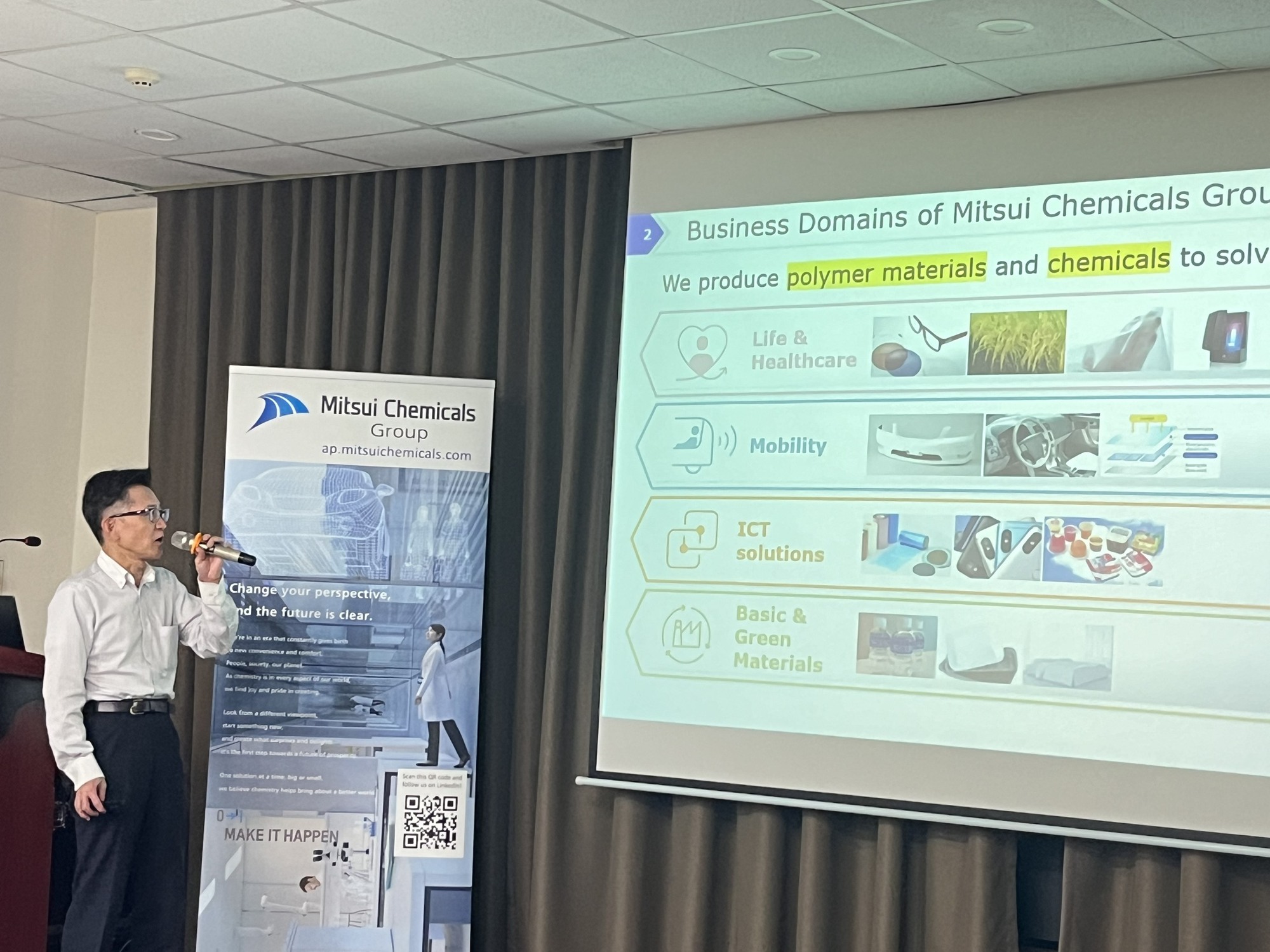
Mitsui Chemicals pitches “in reverse” in Vietnam for the first time – Photo by VGP/Le Ngoc
Recently, Mitsui Chemicals—one of Japan’s leading corporations in advanced chemicals and materials—partnered with KisStartup to launch the “Reverse Pitch” initiative, attracting great interest from scientists, universities, research institutes, startups, and businesses across Vietnam.
This open innovation initiative is organized as a reverse pitching event, where, instead of startups pitching to corporations, Mitsui Chemicals took the lead in presenting its proprietary technologies and inviting external partners to collaborate on further development.
Mr. Kaneyoshi Hiromu, Executive Director of Mitsui Chemicals Singapore R&D Center, shared that the initiative aims to foster connections with startups, scientists, and R&D teams in Vietnam, with a vision to co-develop or co-invent new technologies.
The program focuses on high-potential areas such as thermoplastic material development, polyolefin additives, and gas/moisture barrier solutions. These technologies offer promising applications across diverse industries—from healthcare and food to industrial manufacturing and construction—bringing breakthrough and sustainable solutions.
In 2025, participating startups, scientists, and innovation-driven enterprises will also have the opportunity to compete for the Mitsui Chemicals Award, which includes research funding support.
According to Nguyen Dang Tuan Minh, innovation expert and Founder & CEO of KisStartup, this is a rare form of open innovation in the Vietnamese context.
In typical pitching events, startups and individuals present their ideas to large corporations in hopes of partnership.
In contrast, Mitsui Chemicals publicly shares its patents, capabilities, and cutting-edge technologies. Startups and researchers can then explore these technologies, propose ideas, and collaborate with Mitsui to co-create products and services that unlock their full potential.
Minh further noted that since patents generally have a 20-year lifespan, leaving them unused is a major waste. Innovation should be broadened to actively seek new ideas and external resources.
Why Open Innovation Matters
In today’s fast-changing, globalized world, relying solely on internal resources is no longer sufficient. Businesses must leverage both internal strengths and external capabilities.
Open innovation involves collaboration between corporations and external players—such as startups and research institutions—to solve pressing challenges. At the same time, universities and labs can adopt corporate innovations to address their own problems.
Experts predict that within the next five years, startups will contribute up to 44% of innovation sources for companies of all sizes.
Still, challenges remain. Many corporations have yet to fully “open up” due to market competition. The key is to establish a common ground between stakeholders.
According to Pham Hong Quat, Director General of the National Agency for Technology Entrepreneurship and Commercialization Development (Ministry of Science and Technology), more corporations need to act as “testbeds” for startup solutions.
Beyond financial support, companies should dedicate time, effort, and a share of opportunities to co-develop meaningful innovations that shape the future.
Source: baochinhphu.vn