The Data Loop – From an Operational Tool to a Foundation for Competitive Advantage and Startup Opportunities
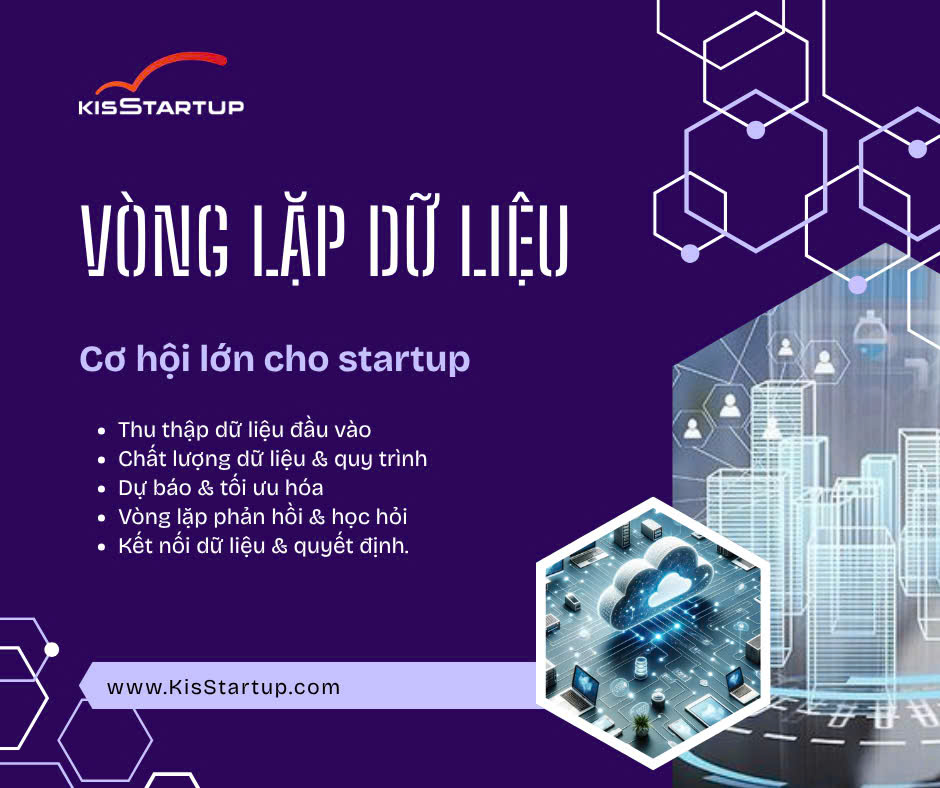 In many organizations, data is often viewed as a “historical report”—used to reflect on what has already happened. However, in modern operating environments, data is no longer just about the past; it forms a continuous learning loop.
This loop distinguishes companies that merely react to the market from those capable of forecasting, adapting, and optimizing in near real time.
More importantly, when examined more deeply, the data loop is not only an internal enterprise matter. It also opens up a vast space for startups to build new products, services, and business models.
When Data Becomes a Learning Loop
A data-driven operating system follows a clear logic:
Decision → Execution → Data collection → Comparison with forecast → Adjustment → Next decision.
This is the learning loop.
For example, a retail company forecasts product demand for the coming week. After execution, it records actual sales and compares them with the forecast. If there is a significant deviation, the company analyzes the causes—promotions, weather, or changes in customer behavior. These insights are then fed back into the system to improve future forecasts.
In logistics, each delivery generates data: delivery time, cost, and delays. When this data is used to update route optimization models, the system becomes increasingly efficient over time.
In workforce management, data on productivity, task completion time, and training effectiveness enables organizations to adjust staffing and training plans based on reality rather than assumptions.
The key point is this: the value lies not in a single analysis, but in the ability to continuously learn from data.
Common Pitfalls That Break the Data Loop
Although the concept of a data loop is not new, very few organizations implement it effectively.
The most common mistake is stopping at reporting.
Companies collect data and build dashboards but fail to use insights to adjust actions. Data becomes decorative rather than actionable.
The second mistake is not measuring forecast error.
Many organizations produce forecasts but do not track deviations between forecasts and actual outcomes. Without understanding errors, the system cannot improve.
The third mistake is failing to capture outcome data.
Organizations implement marketing campaigns, pricing changes, or workforce adjustments but do not systematically measure results. The loop breaks at its most critical point.
The fourth mistake is lacking mechanisms to update models and processes.
Even when feedback data exists, without structured processes to update models or adjust operations, the system cannot evolve.
Real Value: From Operational Optimization to Competitive Advantage
When the data loop is properly implemented, organizations not only improve efficiency but also build sustainable competitive advantage.
First, errors decrease over time. Each iteration allows the system to learn and reduce variance, lowering both cost and risk.
Second, decision-making speed increases. Organizations can adjust operations in near real time instead of waiting for periodic reports.
More importantly, companies gain deeper insights into customers, operations, and markets—insights that competitors cannot easily replicate without similar data systems.
A Major Opportunity for Startups: Building the “Data Loop Infrastructure”
From a startup perspective, the data loop presents a significant opportunity.
Most organizations today lack the capability to build and operate such loops. This gap creates space for startups to participate.
1. Data capture startups – capturing input data
Many companies lack sufficient or granular data. Startups can build solutions such as:
POS, CRM, and ticketing systems
IoT solutions for manufacturing and logistics
Workforce activity tracking tools
This layer represents the entry point of the data loop.
2. Data quality & data pipeline startups
Having data that cannot be used is a common problem. Startups can provide:
- Data cleaning tools
- Standardization and synchronization systems
- Data integration solutions across platforms
- This is the foundational layer enabling analytics.
3. Forecasting & optimization startups
Once data is ready, the next need is prediction and optimization:
- Demand forecasting
- Workforce optimization (e.g., WorkGenda)
- Inventory and logistics optimization
The value lies in aligning models with real business problems.
4. Feedback & learning loop startups
This is one of the most underdeveloped layers. Startups can build:
- Forecast error tracking systems
- A/B testing tools for operations
- Decision performance monitoring platforms
- These solutions help “close the loop.”
5. Decision intelligence startups
At a higher level, startups can go beyond data delivery to recommend actions:
“Increasing evening shift staffing by 10% will reduce wait time by 15%.”
“Reducing price by 5% increases revenue by X but reduces margin by Y.”
This layer connects data directly to decisions.
How Enterprises Can Start Building a Data Loop
Organizations do not need complex systems to begin. A practical approach includes:
Step 1: Select a key decision to ‘datafy’
For example:
Inventory purchasing decisions
Workforce scheduling
Marketing execution
Step 2: Capture data before, during, and after the decision
Before: forecasts, assumptions
During: actual actions
After: outcomes
Step 3: Compare and measure error
Forecast vs. actual
Expected vs. realized results
Step 4: Extract insights and adjust
Were errors due to data or assumptions?
Are there recurring patterns?
Step 5: Repeat and standardize the process
After several iterations, the organization develops a true learning system.
Those Who Learn Faster Will Win—and Startups Enable Faster Learning
In a rapidly changing world, competitive advantage no longer lies in who has more data, but in who learns faster from it.
The data loop is the mechanism that enables organizations to learn.
And the gaps in building and operating this loop represent a major opportunity for startups—not only to provide technology, but to become part of the “nervous system” that helps enterprises make better decisions every day.
© Copyright belongs to KisStartup. Any reproduction, citation, or reuse must clearly credit KisStartup as the source.