Green FinTech and Emissions Measurement: Why It Is Becoming a Global Gateway to Cheaper Capital
KisStartup – Synthesis and Analysis
Green FinTech was once commonly associated with “green investment apps” or environmentally friendly digital banking services. However, between 2024 and 2026, the focus has shifted significantly. Emission measurement technologies and standardized carbon data infrastructure (carbon data + reporting) are increasingly becoming a foundational layer of modern capital markets.
In other words, many Green FinTech solutions no longer begin with carbon credits or green lifestyle products. Instead, they start with a very practical question from banks and investors: How much does a company emit, what is its transition risk, and how reliable is the underlying data?
StartUs Insights notes that the wave of green finance companies and climate-tech solutions is expanding rapidly across Europe, the United States, and Asia. Within this trend, data infrastructure for emissions measurement and management is emerging as a critical enabler for sustainable finance products. [1]
Why Emissions Measurement Is Linked to Cheaper Loans
At its core, interest rates reflect the price of risk. As climate risk and transition risk become integrated into credit models, emissions are no longer a CSR narrative—they become a financial variable.
Research published on arXiv identifies a positive correlation between corporate carbon emissions (particularly Scope 1) and loan spreads. Companies with higher emissions tend to face higher borrowing costs because credit markets increasingly interpret environmental performance as a risk factor. [2]
While each financial institution has its own risk model, the underlying logic is similar:
- Higher emissions → higher perceived transition risk
- Poor or missing emissions data → greater uncertainty
- Greater uncertainty → higher cost of capital
Banks themselves also face pressure to measure financed emissions—the emissions associated with their lending and investment portfolios. The Partnership for Carbon Accounting Financials (PCAF) has established standardized methodologies for measuring and reporting these emissions within the financial sector. [3][4]
As banks are required to disclose financed emissions, they increasingly need carbon data from their corporate clients—especially SMEs—to reduce reliance on rough proxies or estimates. This creates a major opportunity for Green FinTech: transforming fragmented operational data (electricity consumption, fuel usage, logistics, procurement, etc.) into structured carbon datasets that banks can integrate into credit scoring and risk pricing.
Reducing Friction for SMEs
Within the European Union, the issue is often framed as reducing access barriers for SMEs. A report by the Platform on Sustainable Finance highlights the need to simplify and standardize sustainability-related data requirements so that smaller companies can access sustainable financing. [5]
At the same time, policymakers face a delicate balance: sustainability data must be robust enough to maintain the credibility of green finance, yet overly complex reporting requirements could overwhelm SMEs. Consequently, there is growing demand for FinTech solutions capable of delivering emissions measurement that is fast, affordable, and standardized. [6]
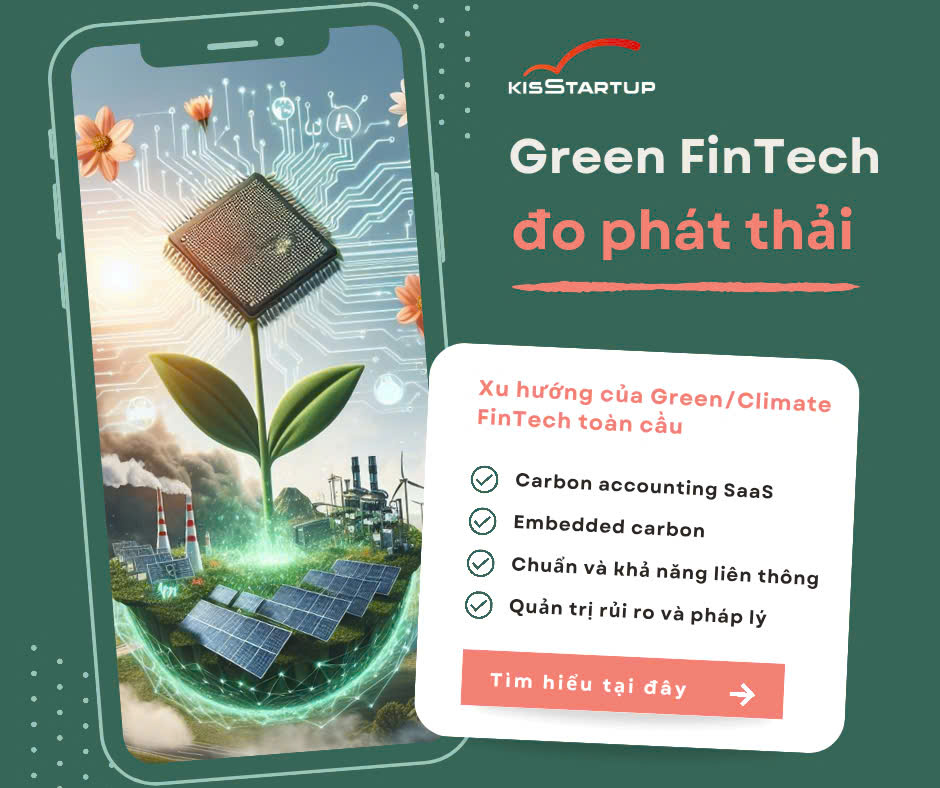
The Global Architecture of Green / Climate FinTech
Across different regions, emissions-focused Green FinTech is converging toward a similar technological architecture.
1. Carbon Accounting SaaS as Data Infrastructure
The first generation of carbon software primarily produced ESG reports. The new generation is evolving into data infrastructure, integrating enterprise systems such as ERP, accounting platforms, invoices, and supply chain databases. This automation enables Scope 3 management and produces audit-ready datasets. Once structured, these datasets can flow directly to banks, insurers, and investors as a new form of financial metadata.
2. Embedded Carbon
Carbon measurement is increasingly embedded within financial workflows—credit assessment, payments, trade finance, and guarantees. In this model, a Green FinTech company may not even be branded as a “carbon startup.” It could be an SME lending platform, trade finance provider, or digital bank that integrates emissions data to offer interest-rate incentives or expanded credit limits.
3. Standards and Interoperability
As multiple frameworks coexist (GHG Protocol, PCAF, corporate reporting standards, taxonomies), the competitive advantage lies not merely in calculating CO₂ emissions but in producing data in formats accepted by financial institutions and investors. CDP emphasizes the importance of aligning data structures between frameworks such as PCAF and CDP to improve usability. [7]
4. Risk Management and Regulation
As Green FinTech becomes more deeply embedded in financial decision-making, regulatory risk becomes more prominent, particularly in jurisdictions such as the EU where sustainability regulations can be interpreted differently across countries. Academic research also highlights the legal complexities of operating Green FinTech platforms within multilayered regulatory frameworks. [8]
This explains why many startups adopt B2B2FI strategies—selling their solutions to financial institutions or operating through compliance-strong partners rather than directly targeting consumers.
Why This Model Is Seen as a “Gateway to Capital”
Across major regions, emissions data is increasingly viewed as a gateway to accessing cheaper capital.
In Europe, regulation and market incentives require sustainability data for capital allocation while also pushing for simplified compliance pathways for SMEs. FinTech platforms can provide scalable digital solutions that banks struggle to build internally. [5]
In the United States, market pressure often comes from investors, supply chains, and large corporate buyers. Carbon reporting is gradually becoming a common language within supply chains and investment due diligence, enabling lower financing costs or access to climate-focused funds.
In Asia, the narrative often centers on ecosystem development. Financial hubs are positioning themselves as leaders in green fintech innovation, viewing climate and ESG data infrastructure as a competitive advantage for their capital markets. [9]
The better a financial center standardizes sustainability data, the faster it can design and distribute green financial products.
Three Critical Challenges for Emissions-Focused Green FinTech
1. Measurement Cost
If carbon measurement tools are expensive or require extensive consulting, SMEs will not adopt them—and banks cannot scale their use.
2. Data Reliability
Carbon accounting is vulnerable to the “garbage in, garbage out” problem. PCAF addresses this by introducing data quality scoring frameworks and encouraging a transition from proxy estimates to real operational data. [3][4]
3. Real Financial Incentives
Green FinTech becomes a true gateway to capital only when companies experience tangible financial benefits: lower interest rates, higher credit limits, reduced guarantee fees, or eligibility for blended finance programs.
Without clear financial incentives, emissions measurement risks becoming merely another reporting obligation.
© Copyright KisStartup. Any reproduction, citation, or reuse must clearly attribute KisStartup as the source.
References
[1] StartUs Insights, “10 Top Green Finance Companies and Startups to Watch in 2026,” Sep. 17, 2025. (StartUs Insights)
[2] arXiv, “Engineering Carbon Credits with AI…” (loan spreads and emissions relationship), arXiv:2501.14750v2, 2025. (arXiv)
[3] PCAF, “The Global GHG Accounting and Reporting Standard for the Financial Industry,” Standard overview page, 2022–2025. (Carbon Accounting Financials)
[4] PCAF, The Global GHG Accounting and Reporting Standard Part A: Financed Emissions (Second Edition), Dec. 2022. (Carbon Accounting Financials)
[5] European Commission (Platform on Sustainable Finance), Report: Streamlining Sustainable Finance for SMEs, Mar. 21, 2025. (Finance)
[6] Reuters, “EU advisers propose plan to cut corporate green reporting by a third,” Feb. 5, 2025. (Reuters)
[7] CDP, “CDP–PCAF Alignment: Simplifying Reporting on Financed Emissions,” Sep. 19, 2024. (cdp.net)
[8] S. Heseková, “Regulatory Risk in Green FinTech: Comparative Insights…,” MDPI Finance Research Letters? (MDPI journal page), 2026. (MDPI)
[9] Fintech News Hong Kong, “Hong Kong’s New Green Fintech Sector Features 64 Companies…,” Aug. 5, 2025. (Fintech Hong Kong)