Afternoon Tea with KisStartup: The Circular Journey of Pineapple
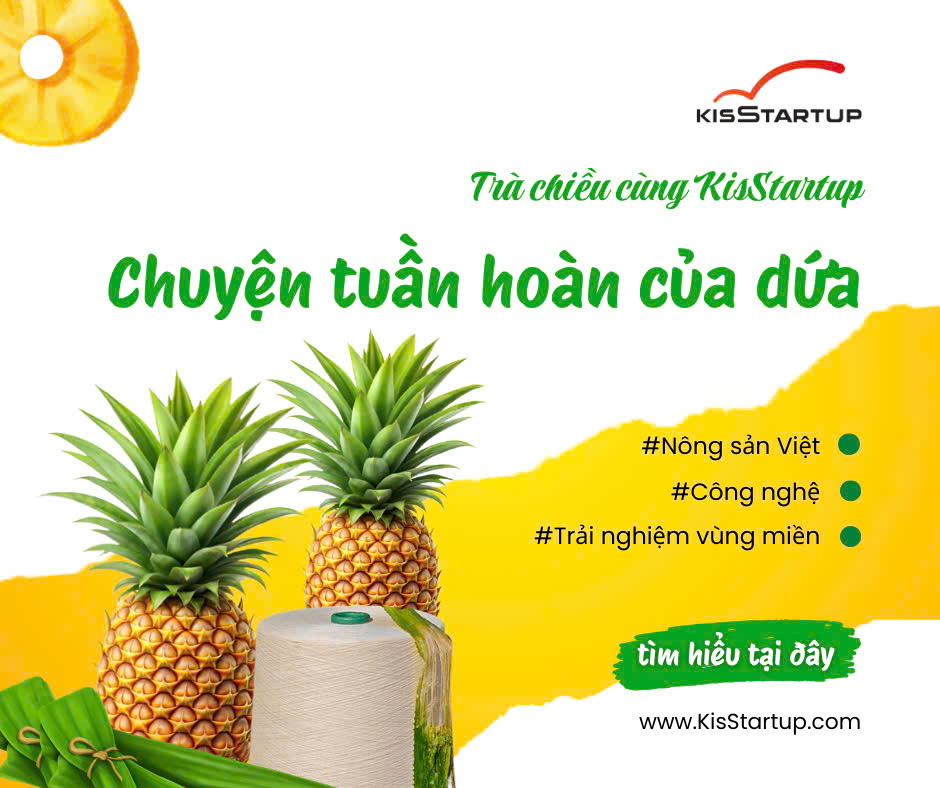
The pineapple plant, much like rice in the history of Vietnamese agriculture, is a paradoxical entity: so familiar that we think we fully understand it, yet constantly confronted with new questions shaped by each era. In the past, the key challenges of pineapple were yield and fresh-fruit markets. Today, the question has expanded: how can every part of the plant—from fruit, peel, core, stem to leaves—be integrated into a value-creating cycle that reduces emissions and regenerates the soil? Globally, answers are gradually taking shape through increasingly diverse processing and biotechnological solutions, forming a clear picture of a circular economy built around pineapple [1].
From upgraded traditional processing to high-value biotechnology
Pineapple processing technologies today span a broad spectrum. At one end are “upgraded traditional” technologies familiar to Vietnam’s agro-processing sector, such as juice, canned pineapple, and dried products. At the other end lie biotechnology, materials, and energy applications—where pineapple is no longer just a fruit, but a feedstock for enzymes, biopolymers, fuels, and novel materials [1].
In fruit processing—the primary product—industrial juice, nectar, and beverage lines have been standardized. A typical process includes grading, washing, peeling, coring, pressing, filtration, Brix and acidity standardization, followed by rapid pasteurization at around 80 °C before bottling or canning. Precise control of temperature and time is critical to preserving pineapple’s natural flavor and color [2]. At a higher level, spray-drying technology converts pineapple juice into instant powder, extending shelf life, reducing logistics costs, and enabling applications in functional foods and instant beverages [3].
For canned and dried pineapple, technological improvements now focus more on quality than volume. Modern canning lines employ vacuum sealing, precise seaming, and pasteurization at 90–95 °C under tightly controlled conditions to ensure food safety while maintaining fruit texture [4]. In drying, combining methods such as low-temperature drying or pulsed electric field (PEF) pretreatment has been shown to shorten drying time, reduce nutrient loss, and better preserve natural color compared to conventional hot-air drying [5].
When by-products become the center of innovation
The real breakthrough of pineapple-based circular economy lies in reimagining by-products not as “waste,” but as the core of technological innovation. Pineapple peel, core, stem, and crown are rich sources of bromelain—an enzyme with high value in food, biomedical, and cosmetic applications. Modern extraction processes prioritize “green” methods, using mechanical grinding with water or buffer solutions, followed by purification via ultrafiltration membranes, dialysis, and concentration. Final products are often freeze-dried to preserve enzyme activity without organic solvents [6]. Some studies report bromelain recovery yields of up to 96.5%, with enzyme activity suitable for food and pharmaceutical applications [7].
Beyond enzymes, pectin, polyphenols, and antioxidants from pineapple peel are increasingly extracted using advanced techniques. Microwave-assisted pectin extraction significantly shortens processing time, improves yield, and enhances molecular structure compared to conventional heating. Other green extraction methods—such as ultrasound, deep eutectic solvents, or supercritical CO₂—enable high-purity recovery of aromatic and bioactive compounds for premium cosmetics and functional foods [8], [9].
Pineapple as a feedstock for bioenergy and biochemicals
At a systems level, many studies and pilot models approach pineapple through a biorefinery lens. Pineapple residues rich in sugars and cellulose can be pretreated, hydrolyzed, and co-fermented to produce bioethanol, integrated with enzyme extraction streams within the same facility. Beyond ethanol, fermentation processes can yield lactic acid, citric acid, xylitol, or liquid biofertilizers—maximizing value extraction from a single biomass stream [10], [11].
Residual biomass after extraction and fermentation can be further processed via anaerobic digestion to produce biogas, or pyrolyzed to create biochar. Biochar derived from pineapple residues, when applied to soil or compost, has been shown to enhance nutrient retention, improve soil structure, and contribute to carbon emission reduction in agriculture [11], [12].
Leaf fiber and materials: where agriculture meets fashion
One of the most visible symbols of pineapple-based circular economy is pineapple leaf fiber (PALF). After harvest, pineapple leaves are processed using decortication machines, then washed, degummed, and transformed into fibers or nonwoven fabrics. PALF has high mechanical strength, making it suitable for textiles and polymer-reinforced composites [1].
Building on this foundation, pineapple-leaf “leather” materials such as Piñatex have brought agricultural by-products into global fashion value chains. The process involves producing nonwoven fabrics from pineapple fibers, then coating them with water-based or bio-based polymers to create leather-like surfaces used in shoes, bags, and accessories. What stands out is not only the material itself, but the way this model connects farmers, material producers, and consumer brands into a low-emission value chain [13].
Implications for Vietnamese startups: technology cannot stand alone
From KisStartup’s perspective, the challenge is not whether Vietnam has access to these technologies, but how to connect them into viable business models. A single startup or cooperative cannot realistically produce enzymes, materials, and energy simultaneously—but it can play a strategic role within one link of a circular ecosystem. The key lies in designing material flows and cash flows so that the by-product of one process becomes the input of another.
In the context of green transition and increasingly stringent emission-reduction requirements, pineapple may follow a path similar to rice: from food security, to export value, and ultimately to a “green” narrative—measurable emissions, verifiable life-cycle impacts, and tangible contributions to soil regeneration. Technology is essential, but it only realizes its full potential when embedded in circular economic thinking, where nature, people, and markets are connected within a sustainable ecosystem.
© Copyright belongs to KisStartup. Any reproduction, citation, or reuse must clearly credit KisStartup.
References (IEEE)
[1] S. R. et al., “Current status, challenges and valorization strategies of pineapple processing waste management,” Sustainable Resources Review, 2023.
[2] Rwanda Agriculture Board, “Pineapple juice processing,” 2020.
[3] P. K. et al., “Spray drying of pineapple juice,” Chiang Mai Journal of Science, 2019.
[4] DOST-ITDI, “Pineapple processing technology,” 2018.
[5] OptiCept, “Harnessing pulsed electric field technology in pineapple drying,” 2022.
[6] A. et al., “Green extraction of bromelain from pineapple waste,” Food Chemistry, 2024.
[7] C. et al., “Membrane purification of bromelain,” Chemical Engineering Transactions, 2023.
[8] M. et al., “Microwave-assisted extraction of pectin from pineapple peel,” Carpathian Journal of Chemistry, 2017.
[9] L. et al., “Green extraction technologies for bioactive compounds,” Journal of Cleaner Production, 2025.
[10] J. et al., “Integrated biorefinery for pineapple waste,” Journal of Cleaner Production, 2017.
[11] IJSRBP, “Valorization of pineapple waste into bioenergy and biofertilizer,” 2025.
[12] Frontiers in Agronomy, “Biochar from agricultural residues,” 2024.
[13] Design Life-Cycle, “Piñatex: pineapple leaf fiber leather,” 2020.