Cal AI: From Meal Photos to a Million-Dollar Gen Z Startup
(Trend, Technology & Growth Model Analysis 2024–2025)
KisStartup – compiled, analyzed, and edited
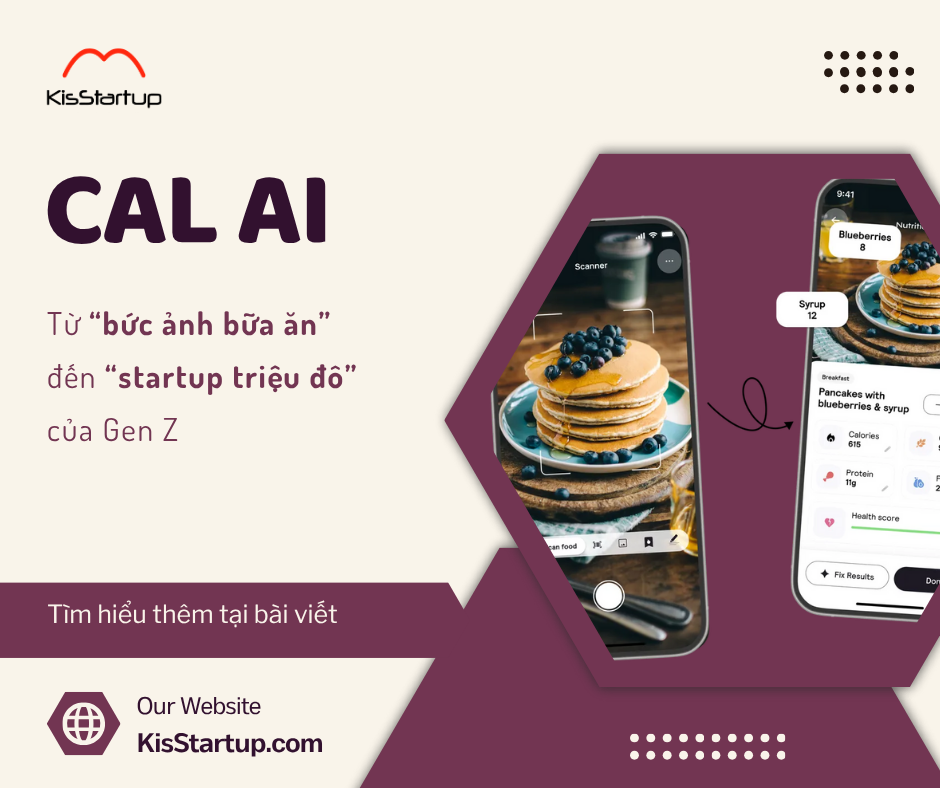
Cal AI is a mobile application that lets users snap a photo of their meal and instantly receive estimated calories, protein, carbs, and fat—almost immediately. No more typing “150g chicken breast, half a cup of brown rice…” line by line. The app uses computer vision to identify dishes and estimate nutritional composition from real-world images. According to internal figures and media interviews, its accuracy hovers around 90%, comparable to—or even slightly better than—the variations often found on packaged nutrition labels, which can deviate by up to 20%.
Behind this product is not a major healthcare corporation or a billion-dollar venture fund. It was built by a group of 17–18-year-olds in the United States.
Cal AI was created by Viral Development LLC, founded by Zach Yadegari, Henry Langmack, Blake Anderson, and Jake Castillo. What’s striking is not just the business results but the sheer speed at which they transformed a personal question—“How do I eat enough calories to gain muscle?”—into a global leader in nutrition tracking in under a year.
How fast has Cal AI grown?
Launched in May 2024, Cal AI quickly climbed to the top ranks of Health & Fitness apps on both the App Store and Google Play. Viral campaigns on TikTok and Instagram acted as the engine for early growth: videos like “take a picture of a bowl of bún bò and instantly see the calories” blended entertainment with immediate utility, converting viewers into downloads at remarkable speed.
Within eight months, Cal AI surpassed five million downloads. Revenue jumped from USD 28,000 in the first month to over USD 100,000 the next, and crossed USD 1 million in monthly revenue by late 2024. By early 2025, the app was generating roughly USD 12 million in annual recurring revenue, and continued to climb into the USD 30–34 million range through the first half of 2025, according to interviews with the founders and data from Sensor Tower and app-tracking platforms.
Throughout 2025, Cal AI sustained hundreds of thousands of new downloads each month, remained in the upper tiers of high-grossing Health & Fitness apps, and showed consistent weekly recurring revenue. Notably, the team claims to have grown without traditional venture capital—building a rare, bootstrapped success in a sector usually dominated by heavy ad spending and delayed monetization.
Why are users choosing Cal AI?
Users don’t choose Cal AI because “AI” sounds trendy. They choose it because it solves a universal pain point: logging meals is tedious. Traditional apps like MyFitnessPal require manual entry or searching through a massive community-generated database. This is accurate but slow and often discouraging.
Cal AI compresses the entire workflow into one step: open camera → take a photo → receive macronutrient estimates and portion suggestions. The app also personalizes intake recommendations based on your history and goals—cutting fat, maintaining weight, or bulking. It allows users to set targets, track visual progress, sync with Apple Health or Google Fit, and combine calorie intake with movement data to calculate “remaining calories for the day.” The experience is more like having a pocket nutrition coach than a food diary.
Key features highlighted by users and the media include real-time AI food recognition, barcode scanning for packaged goods, progress charts, fitness data syncing, and a group-logging mode that lets friends track meals together. Cal AI reframes calorie tracking from a discipline-heavy task into something closer to a playful feedback loop—one reason the app spreads rapidly on TikTok: it’s instantly “show-off-able.”
Technology: more than “AI that sees food”
At its core, Cal AI uses large vision models trained on millions of food images paired with nutritional data, continuously improved with user-generated input. The team reports around 10% nutritional estimation error—sufficient for real-world fitness goals, though not for clinical or professional athletic contexts.
Importantly, the system doesn’t just label dishes; it estimates quantities. A plate of chicken rice might be broken down into “~180g white rice + ~120g chicken breast + ~10g oil,” enabling more accurate macros and actionable suggestions like “you’re still ~20g short of your daily protein goal.” The founders did not attempt to build a giant new model from scratch; instead, they assembled existing technologies—Python, Node.js, commercial AI APIs—and rapidly iterated on a narrow vertical problem. This is a true “vertical AI” approach: do one specific thing extraordinarily well.
The business model: why does Cal AI make so much money?
The app follows a common premium health-app strategy: free download, full trial for a few days, then a paywall for its core “wow” features like AI photo analysis and deep personalization. Subscriptions range from a few dollars to tens of dollars per month depending on region. The team has publicly suggested a conversion rate of 20–30% from trial to paid—a remarkably high figure for consumer apps.
This means Cal AI doesn’t need tens of millions of free users to earn significant revenue. A few hundred thousand active users with a high paying percentage yields multi-million-dollar monthly revenue and healthy margins—allowing the company to remain self-funded.
Instead of burning money on performance ads, Cal AI invests heavily in micro- and mid-tier influencers. They don’t just pay creators; they co-design the content—camera angles, the first three-second hook, how the calorie scan is displayed—optimizing for both virality and conversion. This is growth in a distinctly Gen Z fashion: marketing is the product being demonstrated.
Cal AI vs. MyFitnessPal vs. SnapCalorie
Calorie-tracking is not a new category. MyFitnessPal has existed for over a decade with a vast database and wide integrations but is often criticized for being clunky, ad-heavy, and outdated in user experience. SnapCalorie offers similar AI-based food recognition and positions itself as a friendly, usually free gateway for users reluctant to pay for Cal AI. However, SnapCalorie imposes daily limits on free scans and is still in community-building mode rather than aggressive monetization.
The competitive landscape looks roughly like this: Cal AI delivers fast AI, personalization, and strong monetization; MyFitnessPal offers data depth and legacy; SnapCalorie focuses on a free, minimalist experience. Users choose based on their goals—maximum convenience and coaching, database-driven logging, or no-cost entry.
Why Cal AI is a case study for founders
The app has become a staple example in entrepreneurship, growth marketing, and young-founder workshops for three main reasons. First, its problem statement is razor-sharp: it solves the everyday challenge of not knowing how many calories you just consumed. Second, its time-to-market was incredibly fast—ideation in early 2024, launch in May, and USD 1M monthly revenue by the end of the year. Third, it proved monetization early, avoiding the trap of viral but unprofitable AI applications. The team embraced a Gen Z message: “We don’t need VC money to build a real startup.”
Challenges and open questions
Despite the hype, Cal AI faces real concerns. While 90% accuracy sounds impressive, it still leaves a margin that is too wide for professional athletes or clinical use. Revenue may fluctuate with seasons, influencer campaigns, and pricing experiments; long-term retention is still unproven. The app is also facing an avalanche of clones with similar names, potentially diluting brand recognition. And regulatory scrutiny looms: when apps give dietary recommendations, where is the line between wellness guidance and medical advice?
Why Cal AI matters for Vietnamese founders
Cal AI demonstrates that “AI + a specific problem + fast shipping + instant monetization” can produce a financially sustainable business within a year, without needing venture capital. It also challenges two common assumptions. The first is that building a health-related tech product requires medical credentials or age seniority. Here, the pain point—daily calorie discipline—is universal, and the founders solved it because they personally lived it. The second is that “no one will trust you if you’re not even in college.” Zach Yadegari, rejected by more than 15 top universities (including Harvard and MIT), now runs a multimillion-dollar AI app at 18—a narrative that has become emblematic of Gen Z entrepreneurship: self-taught, self-built, and self-funded.
For young Vietnamese aspiring founders—especially in vertical-AI domains like agriculture, local tourism, community health, personalized education, or farm-to-market logistics—the real takeaway is not “let’s build another AI calorie app.” It is the discipline of choosing a problem so specific it fits in one sentence, solving it ten times better than the status quo, charging real users early, and iterating relentlessly using real-world data rather than pitch decks.
Cal AI shows that the new generation of founders is not building “AI startups.” They are using AI to reshape everyday habits—and generating revenue from day one.
It brings nutrition management out of the realm of tedious spreadsheets and into an experience as simple as taking a meal selfie. And for the startup ecosystem, it sends a clear signal: Gen Z is not waiting for permission. They are creating their own opportunities—and counting revenue in millions—at eighteen.
© Copyright belongs to KisStartup. Any form of reproduction, citation, or reuse must include clear attribution to KisStartup.
References:
Toolify.ai. “Cal AI Detailed Review – Is the AI Calorie Tracker Really Effective?”
VNReview. “Cal AI’s Incredible Success Story Created by 2 18-Year-Olds.”
Use Vietnamese Goods. “A 17-Year-Old Boy and a Million Dollar App – The Story of Cal AI.”
App Store listing: “Cal AI – Calorie Tracker” (Viral Development LLC, id6480417616).
Google Play listing: “Cal AI – Calorie Tracker” (com.viraldevelopment.calai).
eesel.ai Blog. “Cal AI Pricing.”
Thanh Nien Newspaper. “Cal AI App Owner Goes Viral, Rejected by 15 Top Universities.”
TopAIToolsReview. “Cal AI.”
GenK. “This AI calorie counter app makes over $12 million a year – I downloaded it to try it out to see if it really works.”
Vietnam Market Report (Facebook group). Discuss/evaluate Cal AI’s business performance.
Reddit r/nutrition. “Anyone have success using Cal AI?”
AI Artworks VN group (Facebook). Discuss Cal AI.
Personal Facebook post (Image ID: 1053996389879059) about the experience of using Cal AI.
Reddit r/SaaS. “How the fast-growing Cal AI app is converting like crazy.”
App Store listing: “Caloric AI – Calorie Tracking” (id6499521146).
Google Play listing: “Calorie Tracker, Calorie Counter, Calculator” (com.calorietracker.caloriecounter.calculator).
App Store listing: “Pro Cal AI – Calorie Counter” (id6523421188).
Google Play listing: “Dr Cal – AI Calorie Counter” (com.drcal.aicaloriecounter).
Cal AI homepage (calai.app).
Google Play listing: “Food AI Scanner / Food Calorie Scanner” (com.foodAiScanner.foodAiScanner).
Elite Fitness Alliance. “Best Calorie Tracking Apps – Comparison.”
Limotein. “The Great Comparison: Limotein vs MyFitnessPal vs Cal AI – Which app is truly smart in 2025?”
SnapCalorie Blog. “Looking for a free Cal AI alternative? Here’s the ultimate solution.”
SnapCalorie Blog. “Best MyFitnessPal alternative 2025 – Meet SnapCalorie.”
Jotform AI. “Best AI Calorie Tracker.”
YouTube. Video review “Cal AI Pricing / Calorie Tracking with AI” (ID: ZoirXvRf9yc).
WellnessPulse. “SnapCalorie AI Image Tracker Review.”
GarageGymReviews. “MyFitnessPal Review.”
Instagram Reel (ID: DG8f2OBs6Ip). Compare MyFitnessPal vs Cal AI.
LinkedIn post by NayCook. “MyFitnessPal is getting destroyed by this…” (competitive analysis with Cal AI).
YouTube. “Does Cal AI work?” (ID: T8rpi_9EguU).
Reddit r/MyFitnessPal. Discuss “Cal AI app.”
YouTube Shorts (ID: NTsskM-Jd2A). Compare Cal AI / SnapCalorie.
GarageGymReviews. “Best Calorie Counter Apps.”
YouTube Shorts (ID: YWGKsGWHrhM). SnapCalorie Tutorial.
Forbes Health. “Best Calorie Counting Apps.”
TikTok. Topic ‘cal ai vs myfitnesspal’.
YouTube. “The future of calorie tracking with AI” (ID: j36Hb9iGFc4).
SnapCalorie Blog. “Is there a free version of Cal AI?”
YouTube. “AI calorie tracking face-off: Cal AI vs others” (ID: -_Ds_xDpGN4).
Chan Dat / Chandat.net. “Zach Yadegari – 17-year-old boy earns million dollars/month from AI app.”
VNReview. Profile of Cal AI founder and teenage startup story.
CNBC. “How a teenage CEO built a fast-growing calorie tracking app (Cal AI).”
What A Startup (Substack). “Two Gen Z founders bootstrapped Cal AI.”
MoneyMakingStory. “How a 17-year-old built a $1M/month AI app.”
Business Insider. “How I co-founded a million-dollar app, Cal AI, with a teen.”
Use Vietnamese Goods. “A 17-year-old boy and a million-dollar app – the story of Cal AI.”
Microempires. “Cal AI.” (analysis of bootstrapped model / revenue growth).
New Newspaper. “How a high school student earned $12 million thanks to AI.”
CafeF. “18-year-old boy becomes a phenomenon thanks to owning an AI app that earned $1.4 million/month in profit.”
Thanh Nien. “Cal AI app owner was rejected by 15 top universities.”
Zing News (Lifestyle). “18-year-old millionaire was rejected by Harvard, MIT and many other US universities.”
MarketTimes. “Students running AI applications earn up to 1.4 million USD/month, manage dozens of employees.”
Dan Tri. “17-year-old boy earns 12 million USD/year thanks to artificial intelligence.”
Bao Moi. “18-year-old CEO runs a million-dollar startup but is still rejected by Harvard and MIT.”
Vietnam Market Report (Facebook group). Analysis of Cal AI's user acquisition price and influencer marketing strategy.
UEH Future / ICDAM 2025 content related to young intellectuals and AI.
YouTube. Interview with Zach Yadegari / startup story (ID: CLYVfsOLSsE).
Channel 14. “17-year-old boy earns 1.12 million USD/month… paying the whole team thanks to an AI app.”