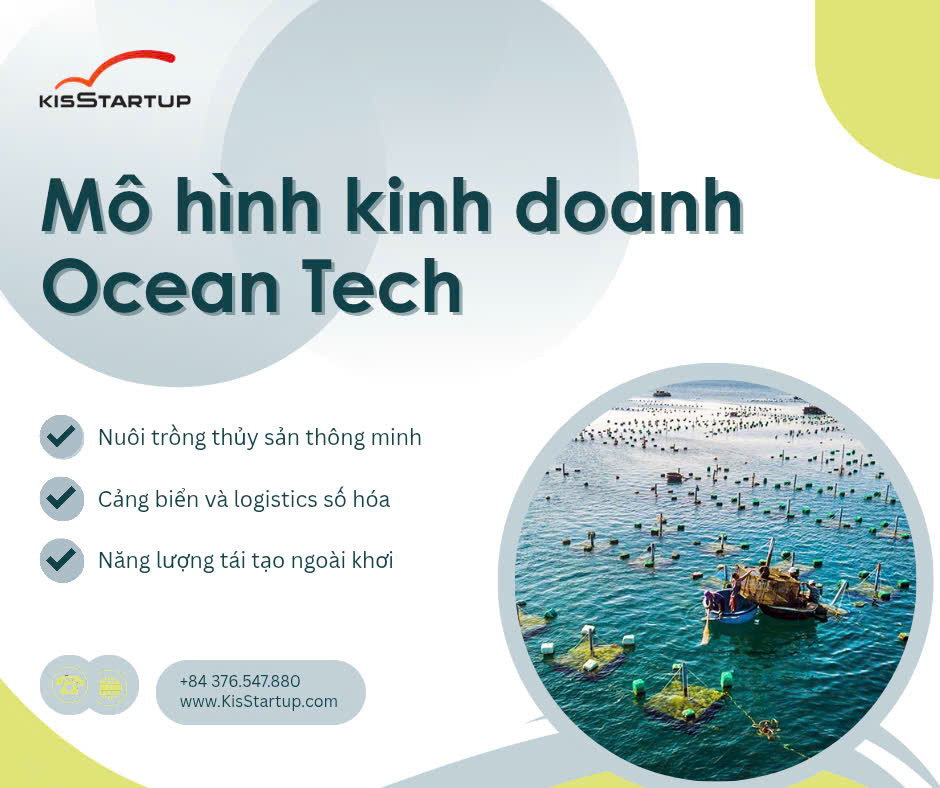
Ocean Tech is not a single technology sector but a constellation of business models focused on reducing risk, lowering costs, and improving efficiency in ocean-based economic activities—domains typically characterized by high capital intensity, fragmented data, and significant uncertainty. By examining Ocean Tech applications in Vietnam—such as smart aquaculture, digitalized ports, and offshore renewable energy—alongside global success models, several core business logics become evident.
Smart Aquaculture: Hardware as the Entry Point, Data as the Core Asset
Aquaculture technology models in Vietnam, such as RYNAN Smart Aquaculture and IoT/AI solutions like Bosch AquaEasy by Bosch, reveal a key insight: customers do not buy technology—they buy risk control.
In shrimp and fish farming, where margins are thin and environmental risks are high, the value of technology lies in reducing failure probability rather than maximizing output. RYNAN’s integrated IoT–cloud–analytics ecosystem enables automation, traceability, and compliance with sustainability standards, extending value beyond farm operations into market access and regulatory alignment.
Revenue models increasingly combine hardware sales with recurring service fees for monitoring, alerts, and technical support—reflecting a shift from CapEx to OpEx, which is critical for adoption in emerging markets.
Globally, platforms like Aquaconnect illustrate a common trajectory: starting with advisory and data acquisition, then expanding into input/output marketplaces, and eventually financial and insurance services powered by risk data. The most significant revenue opportunities lie not in standalone software, but in value-added services unlocked by data scale.
Ports and Maritime Logistics: Digitizing Costly Waiting Time
In ports and maritime logistics, Ocean Tech is most visible in the digitalization of operational decisions that directly impact fuel costs, time, and emissions. Systems such as ePort, Smart Gate, and Terminal Operating Systems (TOS) implemented by Vietnam Maritime Corporation (VIMC) demonstrate a clear business logic: every hour of reduced vessel waiting time translates into tangible cost savings.
These systems not only improve internal efficiency but also generate high-value operational data. Once standardized, this data enables integration with higher-level Ocean Tech solutions such as route optimization, emissions management, and multimodal logistics coordination.
Saigon Newport Corporation further positions smart ports within a “green logistics” framework, aligning digital transformation with long-term sustainability goals.
Globally, companies like Portchain and Awake.AI follow a similar SaaS-based B2B subscription model. However, their true competitive advantage lies in network effects and system interoperability. Increasingly, ESG and decarbonization requirements—driven by global shippers and the International Maritime Organization—are becoming primary purchasing drivers rather than optional value-adds.
Offshore Renewable Energy: Value Concentrated in O&M and Risk Management
Offshore wind is often viewed as a capital-intensive sector, but from an Ocean Tech perspective, long-term value resides in lifecycle services and digital layers surrounding the asset.
PetroVietnam Technical Services Corporation (PTSC) exemplifies how local firms can transition from oil and gas to offshore wind value chains, covering geophysical surveys, fabrication, and operations & maintenance (O&M).
Internationally, however, margins and scalability are increasingly concentrated in digitalized O&M, digital twins, and structural risk management. Platforms such as Akselos provide real-time structural performance monitoring, enabling optimized maintenance schedules and reduced downtime—one of the most expensive factors in offshore wind operations.
This marks a shift from project-based revenue models to recurring, data-driven service models.
Common Patterns in Ocean Tech Business Models
Across these sectors, several structural trends emerge:
Hardware-enabled SaaS dominates: Ocean Tech rarely operates as pure SaaS. Solutions are tightly coupled with physical environments and real-world data collection.
Data moat outweighs technology moat: While sensors and algorithms can be replicated, long-term operational datasets—on aquaculture conditions, vessel routes, or metocean factors—form the true competitive barrier.
CapEx-to-OpEx transition is critical: Subscription models, equipment leasing, or outcome-based pricing reduce adoption barriers and create stable recurring revenue streams.
Anchor clients drive early growth: Large enterprises in ports, energy, or aquaculture act as first buyers, providing both revenue and real-world data environments for product validation.
Successful Ocean Tech models follow a consistent logic: start with a clear ROI-driven problem, deploy field-integrated solutions, generate recurring revenue, accumulate proprietary data, and expand into higher-value services.
With its extensive coastline, strong domestic demand, and supportive policy direction, Vietnam is not only a promising market for Ocean Tech adoption but also has the potential to develop scalable business models for regional and global markets—provided startups identify the right niche and design robust models from the outset.
© Copyright KisStartup. Any reproduction, citation, or reuse must clearly attribute KisStartup as the source.
References
[1] RYNAN Smart Aquaculture, “Shrimp Forever – Smart Aquaculture Solutions,” 2023. [Online]. Available: https://rynanaquaculture.com/blog/shrimp-forever
[2] VietFish Magazine, “Bosch AquaEasy – An IoT Solution for Shrimp Farmers,” 2022. [Online]. Available: https://vietfishmagazine.com/news/bosch-aquaeasy-an-iot-solution-for-shr...
[3] S2G Investments, “Welcome Aquaconnect,” 2022. [Online]. Available: https://www.s2ginvestments.com/insights/welcome-aquaconnect
[4] Vietnam Maritime Corporation (VIMC), “VIMC Develops Digital Logistics Ecosystem,” 2023. [Online]. Available: https://vimc.co/en/vimc-develops-digital-logistics-ecosystem/
[5] Saigon Newport Corporation, “Creating the Green Logistics Ecosystem,” 2023. [Online]. Available: https://saigonnewport.com.vn/en/article/maritime-news/saigon-newport-cre...
[6] Portchain, “Port Call Optimization Platform,” 2023. [Online]. Available: https://portchain.com/home
[7] Awake.AI, “Smart Port as a Service,” 2023. [Online]. Available: https://www.awake.ai
[8] PetroVietnam Technical Services Corporation (PTSC), “Renewable Energy – Offshore Wind Services,” 2023. [Online]. Available: https://www.ptsc.com.vn/en-US/renewable-energy
[9] Akselos, “Structural Performance Management for Offshore Assets,” 2022. [Online]. Available: https://akselos.com