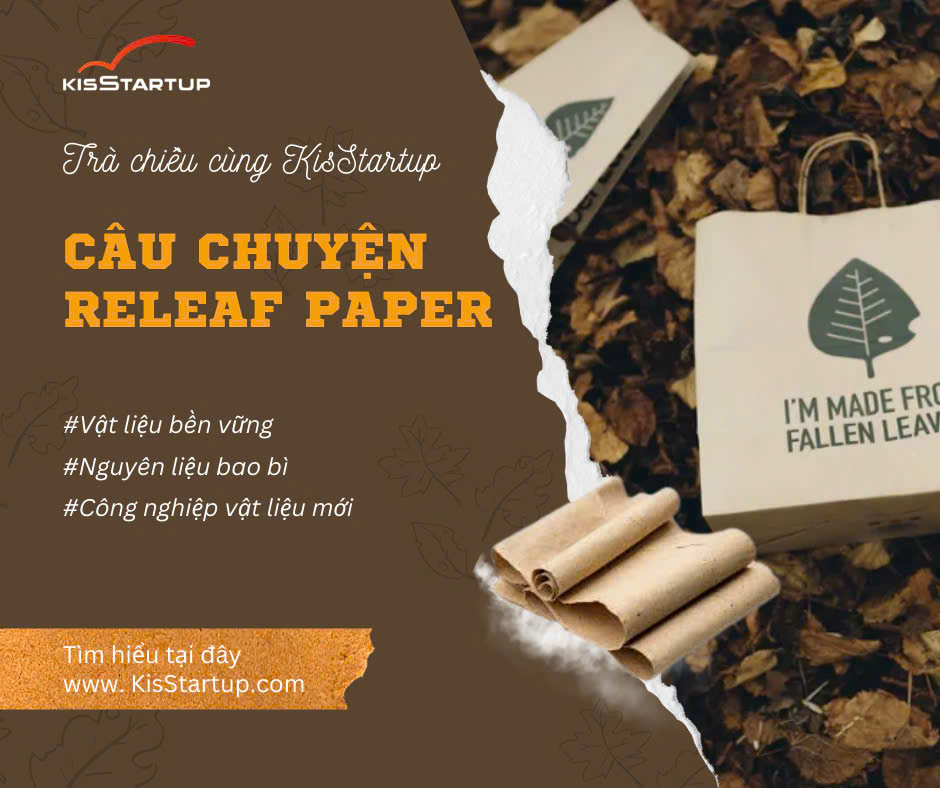
In many conversations at KisStartup, an interesting question often arises:
Can urban “green waste” be transformed into a new materials industry?
Releaf Paper offers a compelling example of how a deep-tech startup can build an entire business model around an overlooked resource: fallen leaves.
In most cities around the world, fallen leaves are collected as organic waste and then burned, landfilled, or composted. This process incurs costs for municipalities while generating limited economic value.
Releaf approached the issue from a different perspective:
If fallen leaves contain cellulose just like wood, why not use them to make paper?
From a materials science perspective, fallen leaves still contain a significant amount of cellulose, the primary component used in paper production. However, unlike wood, leaves have a softer structure, contain more impurities, and decompose more easily. As a result, extracting usable fibers requires an entirely different technological process.
This is where Releaf’s core technology comes in. The startup developed a patented process that combines mechanical, thermal, and chemical treatments to extract cellulose from fallen leaves and other forms of green biomass. The process uses familiar industrial equipment such as reactors, grinders, and paper-making machines, but with specialized treatment stages that enable the production of fibers strong enough for paper and packaging.
A notable aspect of Releaf’s technology is that it does not use sulfate, sulfite, or chlorine—chemicals commonly used in traditional paper manufacturing. As a result, the process significantly reduces water and energy consumption while simplifying wastewater treatment.
According to assessments from European Union innovation programs, this technology can reduce CO₂ emissions by approximately 78%, use 15 times less water, and consume three times less electricity compared to conventional wood-based paper production.
In addition, paper produced from leaves can be recycled up to five times or biodegrade within 30–60 days, making it well aligned with circular packaging models.
Beyond Paper: A Green Biomass Processing Platform
From a technological perspective, Releaf is more than a paper company. It is building a green biomass processing platform, capable of transforming materials such as fallen leaves, small branches, agricultural residues, and post-harvest plant stems.
This approach opens the possibility of expanding into multiple applications, including containerboard, tissue products, packaging materials, and potentially bioplastic feedstocks in the future.
The Business Model: Local Waste → Local Packaging
What makes Releaf particularly interesting is its business model.
Instead of building a complex global supply chain like the traditional paper industry, Releaf designed a “local green waste → local packaging” model.
Fallen leaves are collected from local cities, processed into cellulose pulp, and then sold to nearby paper mills or packaging manufacturers. This approach reduces raw material costs while also minimizing logistics expenses.
From a circular economy perspective, the model transforms what used to be a municipal waste management cost into an industrial raw material.
Within this value chain, Releaf generates revenue through multiple streams:
- Selling Releaf Filler, a cellulose filler derived from leaves for paper manufacturers
- Producing leaf-based kraft paper for packaging applications
- Providing sustainable packaging solutions for brands seeking environmentally friendly alternatives
Target customers typically include large companies under strong ESG pressure, such as FMCG, fashion, cosmetics, and e-commerce brands.
In this sense, the value of Releaf lies not only in the material itself, but also in the environmental narrative that brands can communicate to their customers.
A paper bag made from leaves collected in a city park can become a powerful symbol of circular economy thinking.
A Lesson in Innovation
As Europe tightens regulations on single-use plastics and carbon emissions, technologies like Releaf may become an integral part of the next generation of sustainable materials ecosystems.
From a startup perspective, the biggest lesson from Releaf may be simple:
Innovation does not always come from inventing new materials—sometimes it comes from rethinking what we call waste.
In a world striving to reduce emissions and protect natural resources, something as ordinary as fallen leaves—once considered worthless—may become the raw material for a multi-billion-dollar industry.
© Copyright KisStartup. Any reproduction, citation, or reuse must clearly attribute KisStartup as the source.