
Vietnamese businesses “reverse pitch” for the first time to seek ideas from the outside.
On the morning of March 4, nine experts from the LIF Global 2025 program in Vietnam held a discussion with Ho Guom Group to help the company address internal challenges.
This marked the first-ever “reverse pitching” session by a Vietnamese business, where the company proactively “opened up” about its internal problems to seek solutions from external innovators. This reversed the traditional model, in which innovators or tech startups typically pitch their ideas to businesses in hopes of investment or adoption.
With over 30 years of development across sectors such as garment manufacturing, real estate, education, and technology, Ho Guom Group is now looking to undergo digital transformation, starting with solving product congestion on its textile production lines. The company found the right partner in LIF Global (Leaders in Innovation Fellowships)—a program focused on building relationships and supporting innovators in developing and commercializing their solutions.
LIF Global is organized by the Royal Academy of Engineering (UK) in partnership with OXENTIA—a global innovation management and technology commercialization consultancy originating from the University of Oxford.
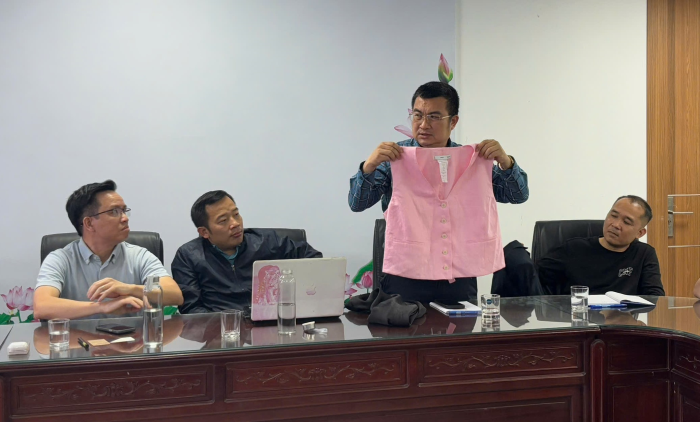
A representative from Ho Guom Group presents the company’s current challenges.
Photo: Diễm Quỳnh
LIF Global brings together innovators from emerging economies worldwide, offering training, mentorship, and networking opportunities to help align their innovations with real-world applications. The LIF Global 2025 cohort in Vietnam includes 9 innovators working across diverse fields such as AI, biotechnology, healthcare, and construction.
Through the Knowledge and Technology Transfer Center (VNU CSK) of Vietnam National University and KisStartup—LIF Global’s local partner in Vietnam—Ho Guom Group was connected with these nine innovators to discuss potential solutions for its production challenges.
Following the discussion, the experts proposed several practical solutions, such as:
Using sensors to detect overload at specific points on the production line, helping plant managers quickly identify bottlenecks.
Applying barcodes to track the movement of each product along the production process.
A representative from Ho Guom Group commented that these ideas are “feasible for implementation” and that the company would further explore and evaluate their application in the factory.
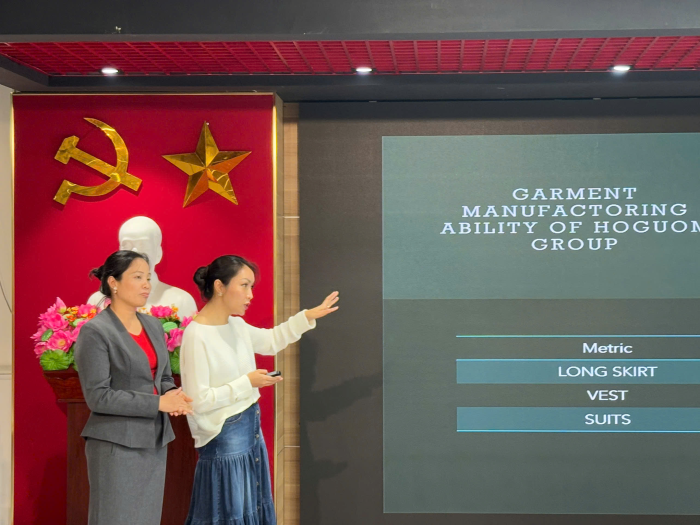
Innovators present their solutions.
Photo: Diễm Quỳnh
Commenting on the discussion, Nguyễn Đặng Tuấn Minh, a representative of KisStartup, with over 10 years of experience supporting the startup community, said, “What’s interesting here is the multi-disciplinary collaboration. If it were only AI innovators, they would only offer AI-based solutions. However, innovators with expertise in other fields bring a creative approach and look at problems from a different perspective, leading to entirely new solutions. Multi-disciplinary collaboration leads to innovations that we cannot even imagine.”
She hopes that businesses will be more open to tackling a wider range of challenges in order to access fresh ideas from diverse innovators in the future.
Link to the full article: Khoa học Phát triển