2026-06-17
Circular economy and "blue coffee" – A new direction for added value in coffee export
If "greening" is a condition to enter the market, then the circular economy is becoming the key to increasing value in the global coffee industry.
From coffee beans to a coffee ecosystem
In the traditional model, the coffee value chain focuses almost entirely on coffee beans. However, reality shows that coffee beans only account for a small part of the entire biomass of the coffee plant. The remaining parts – pulp, husks, coffee grounds, wastewater – were previously often considered waste. Today, from a circular economy perspective, they become raw materials for new industries.
This trend is called the “blue coffee economy”, where the entire production cycle is designed towards zero waste and resource regeneration.
Redefining value: from a single product to an ecosystem
In the new model, businesses do not just sell coffee but can develop multiple product lines from the same raw material source:
- Organic fertilizer from coffee pulp
- Bioenergy from coffee grounds
- Biomaterials and packaging from by-products
- Functional foods or new beverages from coffee extracts.
This helps businesses shift from the "selling raw materials" model to the "maximizing value per unit of biomass" model.
Circular economy combined with green transition
The circular economy is not separated from the green trend, but is a higher stage of its development. If sustainable production helps reduce negative impacts, circularity helps create positive impacts.
Utilizing by-products not only reduces waste and greenhouse gas emissions but also opens up new revenue streams. This is an important competitive advantage as the market increasingly appreciates products with a sustainable life cycle.
How leading countries are moving ahead
Brazil and Colombia are investing heavily in specialty coffee models linked with ecosystem conservation. Meanwhile, many businesses in Europe focus on recycling technology and products made from coffee by-products. Vietnam has also begun to see models utilizing coffee pulp as organic fertilizer, or manufacturing products from coffee grounds. However, most are still at an experimental scale and have not yet formed a complete ecosystem.
The biggest challenge: not technology, but the model
Notably, the biggest barrier does not lie in technology. Technologies for processing by-products already exist. The issue lies in:
- Lack of connection between links in the chain
- Lack of an integrated business model
- Lack of data to optimize material flows
Therefore, the circular economy in coffee is not just a technical story, but a story of redesigning the business model.
Opportunities for Vietnamese businesses
In the context of Vietnam being one of the largest coffee exporters in the world, the circular economy opens up a special opportunity. Instead of only competing in the raw material segment, businesses can:
- Build a product ecosystem from coffee
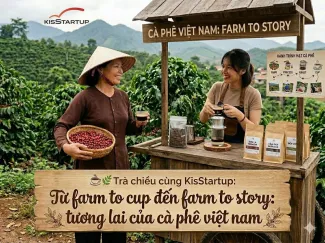
- Combine with experiential tourism (farm – processing – circular story)
- Utilize the "green + circular" story to build an international brand
This is also a direction aligned with sustainable development programs and green finance being promoted globally.
From "green" to "regenerative"
If in the previous stage, the goal was to "do less harm," then the next stage is "to create more positive value."
The circular economy in coffee not only helps businesses increase revenue but also helps reposition the coffee industry as an ecological economic sector – where each product carries not only economic value but also environmental and social value.
© Copyright by KisStartup. Any form of copying, quoting, or reusing must clearly credit KisStartup as the source.
- Log in to post comments
- 30 views