
When Women Are No Longer "Invisible" in Innovation
Inspired by the article "An Invisible Form Programmed by Society" in Tia Sang Magazine
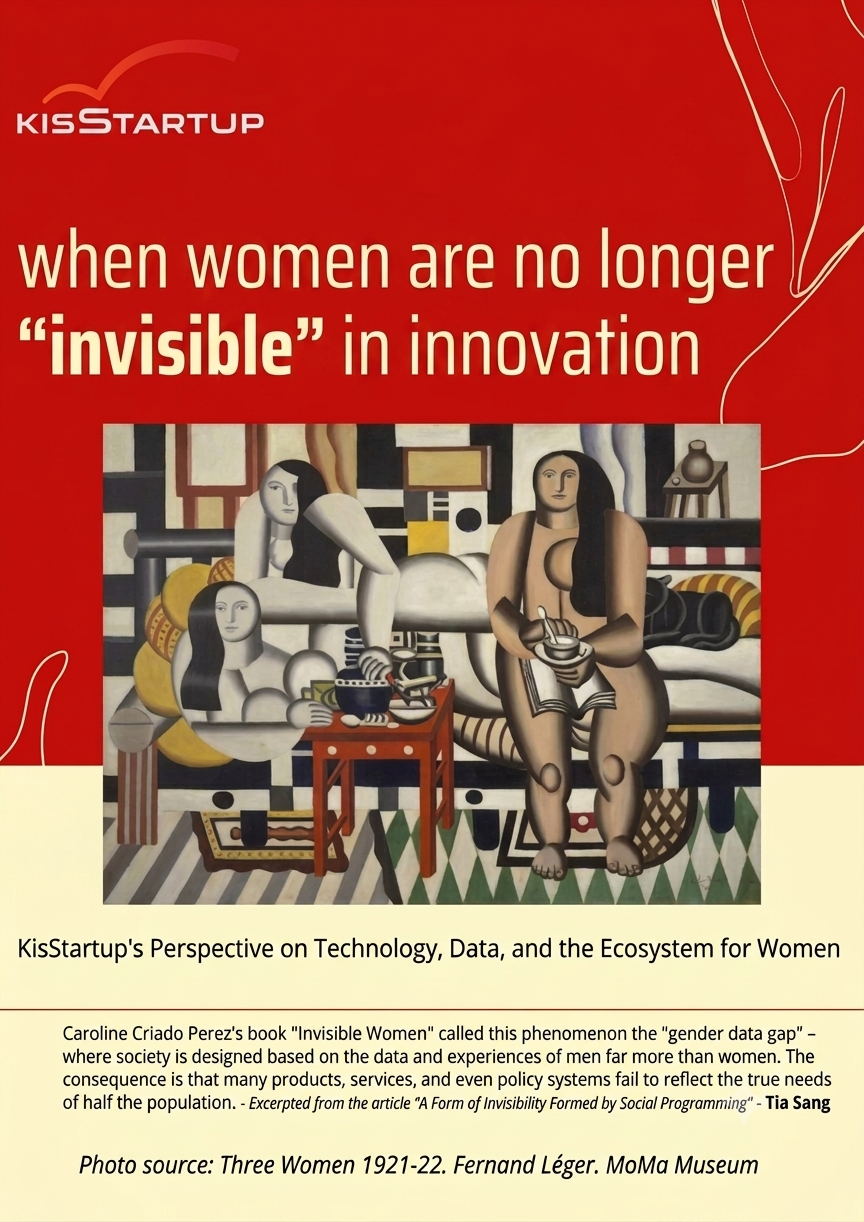
KisStartup’s Perspective on Technology, Data, and the Ecosystem for Women
One of the issues that gives us the most pause when working with local enterprises, particularly women-led businesses, is a glaring paradox: while women play a monumental role in both the economy and society, their needs, experiences, and voices often remain invisible in the design of policies, technologies, and business models.
In book Invisible Women, Caroline Criado Perez conceptualizes this phenomenon as the “gender data gap”—a reality where society is built primarily on the data and experiences of men rather than women. Consequently, countless products, services, and even policy frameworks fail to accurately reflect the needs of half the world's population.
For KisStartup, this narrative is far from an academic debate. It is a highly practical challenge that we encounter daily while working with cooperatives, small businesses, and startup communities across Vietnam.
Women – The Silent Force of Innovation
Across numerous projects rolled out by KisStartup over the past decade-especially programs centered on agriculture, community-based tourism, the green economy, or heritage economics-women have consistently stood at the forefront.
They are the ones who:
- Develop products from indigenous resources.
- Preserve traditional knowledge.
- Organize production within cooperatives.
- Connect communities.
- Engage directly with customers.
In our IDAP (Inclusive Digital Acceleration Program) initiative, over 70% of the participating enterprises were led by women, many of whom belong to ethnic minority groups. They do not merely manage businesses; they anchor their households and communities.
Remarkably, however, the bulk of these contributions remain largely "invisible" within data systems and inside the design of corporate support programs.
Therefore, a core, underlying philosophy at KisStartup remains:
To build a sustainable innovation ecosystem, we must visualize and fully recognize the role of women.
Technology Must Serve Women – Not Just Talk About Women
When discussing digital transformation or innovation, technology is frequently viewed as an end in itself. For KisStartup, however, technology only holds meaning when it serves people-particularly those groups most susceptible to being left behind by economic systems.
Concretely, this means:
- Technology must empower women to save time across order management, customer relations, and marketing.
- Technology must grant women access to broader markets, liberating them from total dependence on middle-traders or traditional sales channels.
- Technology must enable women to tell their own product stories to the world.
In many of KisStartup’s training sessions, we emphasize that digital transformation is not merely about adopting software. It is about shifting business mindsets, re-imagining market connectivity, and restructuring workflows.
For many women entrepreneurs, especially those in mountainous terrain, technology does more than scale a business-it restores valuable time for family and personal life.
Big Data and the Risk of Replicating Inequality
The world is charging into the era of big data and artificial intelligence. Yet, if the foundational baseline data is riddled with gender gaps, future technological systems run the acute risk of replicating and magnifying historic inequalities.
If we fail to harvest data on women, then:
- Products will not be designed to fit them.
- Their markets will remain unseen.
- Support policies will miss the mark.
Across various projects, KisStartup strives to gather data that looks beyond raw revenue or yield statistics, capturing instead:
- The specific roles of women within the value chain.
- The actual labor hours invested by women.
- How decisions are made within the enterprise.
- Their specific needs regarding training and market access.
We firmly believe that data is more than cold numbers. Data is the story, the experience, and the living context of human beings.
Without understanding that context, data can easily lead to flawed decisions.
Women are Not Mere Beneficiaries
A common pitfall across many development programs is treating women solely as passive beneficiaries. KisStartup’s stance is entirely different.
We recognize women as:
- Product innovators.
- Community leaders.
- Entrepreneurs.
- Solution architects for their very own communities.
In many instances, the most inventive business models originate from women precisely because they possess an intimate understanding of market and community needs.
For example, numerous successful community tourism models in Vietnam's highlands are crafted around:
- Family-style meals.
- Cultural narratives.
- Traditional craftsmanship.
- Authentic local life experiences.
These are elements where women naturally take center stage.
When equipped with the right support, they do not just build a business-they generate sustainable livelihoods for an entire community.
Women in Tech and the Innovation Ecosystem
Another systemic hurdle is the stark underrepresentation of women within tech and investment fields.
Startup ecosystems globally remain heavily male-dominated, from tech founders to venture capital funds. This imbalance directly results in tech products being engineered without a genuine grasp of female user needs.
Hence, a strategic direction that KisStartup is passionately driving involves fostering:
- Greater female participation within tech startups.
- The development of products and services engineered by women, for women.
- Active female involvement in the decision-making processes of the innovation ecosystem.
Over recent years, KisStartup has actively pioneered programs related to Femtech (technology dedicated to women’s health and wellness), alongside targeted initiatives that support female entrepreneurship and corporate leadership.
The Future of Innovation Must Be Inclusive
Innovation is not confined to engineering a new product or deploying a novel technology. It is about redesigning how we perceive and structure society itself.
If half of the global population remains "invisible" in data, product design, and executive decision-making, then innovation will forever operate at half of humanity's intellectual capacity.
KisStartup's position is unequivocal:
A sustainable innovation ecosystem must be an inclusive ecosystem.
An ecosystem where:
- Women are fully seen.
- Their voices are genuinely heard.
- Their experiences are embedded into data.
- And they command equal opportunities to invent, build businesses, and lead.
When this shift occurs, innovation will yield far more than raw economic growth. It will forge a society that is measurably fairer, more humane, and deeply sustainable. And perhaps, when women are no longer "invisible," we will discover that many solutions for our collective future have been right there all along, interwoven within their stories, experiences, and wisdom.